Author Archives: John

Aemi’s Journal, Erastus 1, 4719

Petitioner’s Port

evening

I walked alone to Petitioner’s Port. 

Iskaryn objects to my use of the word “alone”, since she was, of course, with me the whole time, but she knows full well what I mean by “I walked alone” and if you want me to do this, Iskaryn, please stop being so pedantic.

I could have waited for other travelers and followed along, or maybe even joined a small traveling group, or waited for a caravan, but honestly? I didn’t want the company, and I really didn’t want to spend another night in Albastrine waiting for company, since that also meant spending more money, and more money is something we just do not have.

See? I said “we” there, Iskaryn. Are you happy now?

Petitioner’s Port is quieter than you’d expect for what was meant to be Druma’s grand southern gateway. The Kalistocracy imagined lines of hopeful petitioners streaming north—hence the name—but the place feels far more practical. Even the road from Isger is called The Path of Commencement, which tells you everything about how the Kalistocracy sees the world. It isn’t the road to Isger: it’s the road from it. As if the only direction that matters is inward.

The town itself never bought into that way of thinking. It grew on its own terms, around work and trade and whatever made sense at the time. It reminds me of Macridi in that way. Half the buildings are redwood, likely cut from the same forests I once walked through. If I’m going to leave Druma, at least I’m doing it from somewhere that feels real.

It occurred to me, because I can see the obvious, that I could just buy passage on a boat from here and be back in Macridi in a couple of days. We could even travel all the way back to Kerse. I said this out loud to Iskaryn, and she screeched so loudly that she stopped traffic on the street. I am not kidding: everyone turned to look at us. Well, the joke was on her, because I just wanted to see what kind of reaction I would get, and she did not disappoint.

Childish of me? Yes. But I’m not pretending that I didn’t enjoy it, and that’s why you shouldn’t read over my shoulder while I am writing in my diary, Iskaryn.

There is no way in the Nine Hells I am walking alone through Isger, so this time, I am waiting for a foot caravan. One is organizing now, and will leave for Saringallow in a couple of days. For once, Iskaryn and I are in agreement: this is not the time to spend my days alone, especially alone and brooding to myself, because it’s just not safe. And while I can’t just get over it, I can learn to live with it, and that is really the first step. So, forced company, it is.

The caravan will stop in Dustspawn, which is a day out of the way in addition to a short layover, and Iskaryn isn’t happy about that (how she knows so much geography is anyone’s guess). I pointed out that we didn’t have much of a choice, and she, grudgingly, agreed. The only reason I am writing down this otherwise unimportant detail is to record that I won that one, even if she only grudgingly admitted it.

There are a couple of decent taverns here, but for whatever reason, I’m not finding my footing in them. The travellers here are more focused on where they are going, or why they are going there, or whatever, and music isn’t really on their minds. I am used to having to perform above the din of a dining hall, but nothing like this. I hope the rest of the trip doesn’t go this way, because we absolutely cannot afford to spend more than we are bringing in.

Iskaryn and I are in agreement on that point, as well.

Aemi’s Journal, Sarenith 28, 4719

Alabastrine

late night

I needn’t have worried. This is the first inn I’ve stayed at in months, and when I looked in a proper mirror, I was shocked by my reflection. I’m so gaunt that I barely recognize myself, and I doubt someone who saw me for a couple of days eight months ago would do so, either. While Davio taught me a handful of spells that were useful for a life spent mostly on the road–including one that kept me clean enough to neither look nor smell like the vagrant I’ve become–none of them provided food. This is what weeks of near-starvation look like.

The point was driven home when I sat down for a late lunch in the common room. The server put a large bowl of stew in front of me and said, “This one is on the house.” I didn’t ask. I knew why.

“I can perform tonight, if you like,” I said to her. The inn was nothing special, but I couldn’t afford better. Truthfully, I couldn’t afford “nothing special”, either, but I had to stay somewhere, and the cheap ones aren’t great for live music. Some aren’t even safe to sleep in. If they’d have me, I could make this one work.

She gave me a skeptical look–I would have done the same in her position–and she told me I’d need to speak to their manager first. Fair enough. It was just another audition, and I’ve had plenty of those.

I’d set aside some of the money for a flute, and finding a simple wooden one in the city markets was easy enough. It was a far cry from what I had been playing the past couple of years, but it would do. A couple of hours later, I was performing for the evening crowd.

As absurd as it sounds, playing taverns and inns along the way is my plan for reaching Breachill without starving. The math barely works. Most nights I’d just break even, but if a few go as well as tonight, I’ll come out ahead. If not… well, I am trying not to think about “if not”.

I’m also trying not to think about Isger. We didn’t spend more than a few weeks there, but that was long enough to make me dread going back. To put it bluntly, I don’t feel safe there.

Traveling the roads in Druma carries little risk. For all that people complain about the Mercenary League being cozy with the Kalistocracy, they do a good job of keeping the trade routes free of trouble. I have walked countless miles both in small groups or completely alone, and I rarely felt threatened. Isger is another matter entirely. I’ll have Iskaryn to watch out for me, sure, but I am better off not traveling by myself.

But that’s a problem for another day.

Aemi’s Journal, Sarenith 23, 4719

Western Druma

evening

I don’t even know what I’m supposed to put in this thing, so I asked Iskaryn, since this was her idea, and she answered, “The truth,” whatever that is supposed to mean. As that was not a helpful response, I followed it up with, “The truth about what?” and she gave me this funny look–and yes, I know she’s a bird, don’t ask me how I know it’s a funny look, I just know–and she said, “About how you feel. About your experiences.”

Except she knows I don’t want to talk about any of those things–I just want to forget most of it–so I said as much, and she just pointed out that this is how I got here. I didn’t have a response to that. Then it hit me: I was being lectured about the healing power of journaling by a magical bird that can’t even read or write.

And I must have said that out loud because she retorted, “I can do both,” and I just stared at her blankly, because what do you say to that? Which she took as a challenge, and proceeded to demonstrate it to me, promptly scratching out the Sylvan equivalent of “See? I told you so” in the dirt. Which is when I realized there was no escaping this trap she has set for me. And, yes, Iskaryn, I know you are reading over my shoulder as I’m writing this, and please stop it.

She objects to me characterizing it as a trap, and insists that this journal, or diary, or whatever I want to call it, was merely a suggestion.

Here’s what she means by “suggestion”: We’re at this trading post where the river–yes, that river–joins the Profit’s Flow, and I’m trying to buy food and water so I don’t starve over the next few days, and because I need a change from living hand to mouth in the wild. She lands on this book with an oil-skinned cover and starts shrieking at me. I try to shoo her away, and she comes back to it and does it again. This repeats a couple more times, and the shopkeeper, who apparently sees birds do this every day because he doesn’t even flinch, says, “I think they want you to buy that.”

Which, of course they would say that, because it’s expensive and they’d love nothing more than for me to give them money. And I’m looking at how many coins I have and realizing, sure, I could get this and a reed pen, or I could maybe eat for three weeks instead, and I try to explain this to Iskaryn–let’s not even go into what that must have looked like, me standing there, arguing with a bird who’s just shrieking back at me because, I don’t know, actually talking would draw too much attention somehow–and she is not having any of it.

I must look like I’m on the verge of a complete breakdown or something, because the shopkeeper takes pity on me–or maybe he just wants us to leave–and offers me a discounted price on it. And all I really want is for Iskaryn to just stop, so I agree to it, and now I’m going to run out of everything by the time I hit Petitioner’s Port. But at least I’ll be able to document it when it happens.

So, yeah. “Suggestion”.

I am supposed to record “the truth”? Okay, fine. Here’s some truth.

It hurts. It’s been almost four weeks and it hurts. Some days it feels like it just happened. Others, it feels like a lifetime ago. But that ache is always there. They’re gone, and there’s this enormous hole inside of me, and I don’t even know how to begin to fill it. And. It. Hurts.

It took me four days just to get out of the forest–four long days of one step ahead of the other, with Iskaryn flitting between branches above me. Then another day, along the road to here, slipping back into the trees whenever Iskaryn spotted someone approaching, because…I don’t know why. I just wasn’t ready to be seen yet. Or maybe I wasn’t prepared to see others. The walking helped, though. It kept me from replaying events. From wallowing in sorrow. It gave me something to do.

It would be so easy to just…give up. Go to Macridi–it’s not even half a day’s walk from here–and step back into that life. I could do it. It’s so tempting to do it. Only, I’m not that person anymore. She never even existed. She was just someone I made up, a role I could play based on half-truths because it didn’t require any difficult choices. So even though I could go back there, I just can’t. Someday, maybe, but not now.

This trading post has a shelter with small rooms that they let out to travelers. The norns didn’t deign to supply me with a schedule, but the way I figure it, they can see the strings of fate, right? So they’ve already seen all this, which means my time spent here is baked in. I’m just going to assume that however long it takes me to get to Breachill is how much time I have, and not fret over a couple of nights in a real bed for the first time in months. It is far from luxury–far from even a rundown inn–but it’s a bed nonetheless, and I’ll take it.

I’ll worry about the rest of it–how I’m going to get there and, more crucially, whether I’ll be recognized in Alabastrine–in the morning.

Qantrip, Female Goblin Witch

This is a summary generated from Qantrip’s full set of background storie (to be posted later).

Qantrip originally belonged to a goblin tribe in Tian Xia, which was decimated by a Chelish wizard who took her to Kintargo as a slave. For months, she was kept under a Dominate spell that forced her to obey his orders without complaint, her true personality trapped beneath a magically enforced mask of contentment. Her daily life was strictly dictated by “riffle scrolls”—repurposed magical scrolls left outside her door each morning containing simple glyphs of her required tasks.

Her chores were grueling and humiliating. She was forced to wash herself with the same harsh lye used for laundry, leaving her skin dry and burning. She fetched cured meats from the cold cellar, often hunting the manor’s rats for a copper bounty and eating them raw herself. She warmed the Master’s bed with hot stones, cleaned his shoes, swept up bat guano, and cared for his pseudo-dragon familiar by secretly feeding it dried fish and cheese.

The Stool and the Angry Cook

One of the most harrowing aspects of her enslavement occurred on Oathdays, when she served as “The Stool”. The Master would use her as a live target for his wizard apprentices, forcing her to sit perfectly still and compliment the students as they successfully cast spells like Blind, Charm, Sleep, Enlarge, Grease, and Fear on her. During this time, she secretly memorized their faces for a future reckoning.

She found small ways to rebel against the manor’s “Angry Cook.” Qantrip took joy in the cook’s misery, referring to past sabotage like the “Pickled Food Breakfast incident”. In one instance, Qantrip decapitated a rat and squeezed its blood over the Master’s chamber pot, horrifying the cook by making it look like the Master was leaking bloody stool. She also secretly collected the Master’s spell components and forged his scrolls to sell to poor wizard students in the market. During her market trips, she befriended a half-orc butcher’s assistant known as “Strong Arms,” who spoke to her in Orcish.

The Duel and Sweet Release

The turning point came when the Master commissioned a guild portrait designed to subtly accuse one of his peers of treason by painting lace on the man’s garments. This insult sparked a magical duel. The Master packed his Chelish red and black robes and left for the duel, but he was killed. With his death, the Dominate spell instantly shattered, releasing Qantrip’s mind.

She released months of suppressed rage in a single scream, terrifying the cook into fleeing. When greedy students arrived to loot the manor, Qantrip used her magic and a stolen scroll to fight them, locking them inside as she set the manor on fire. She watched with satisfaction as one bullying student burned to death after triggering a trapped book. Taking refuge with the half-orc butcher’s assistant, she disguised herself in men’s clothing with short hair. Before fleeing the city, she snuck into the Master’s burial room and stole his skull and femurs.

The Journey to Breachill

Qantrip traveled down the coast by sea, securing passage on the Horizon’s Ledger to Corentyn by offering her magical healing services. She earned the crew’s favor by healing a sailor’s violently broken femur. She then spent six miserable days on the Red Gull of the Jeggare avoiding the cruel Chelaxian captain who ruled by the lash. From there, she traveled down the Conerica Straits on the Bronze Heron, where she happily sang sea shanties with the crew.

Throughout her journey, Qantrip tracked her life on the Master’s stolen femurs. She used boneworking tools to carve smiling goblin heads into a white femur to mark her good days. For her bad days, she used a femur she had blackened by soaking it in a jar of pickling vinegar and rusty nails.

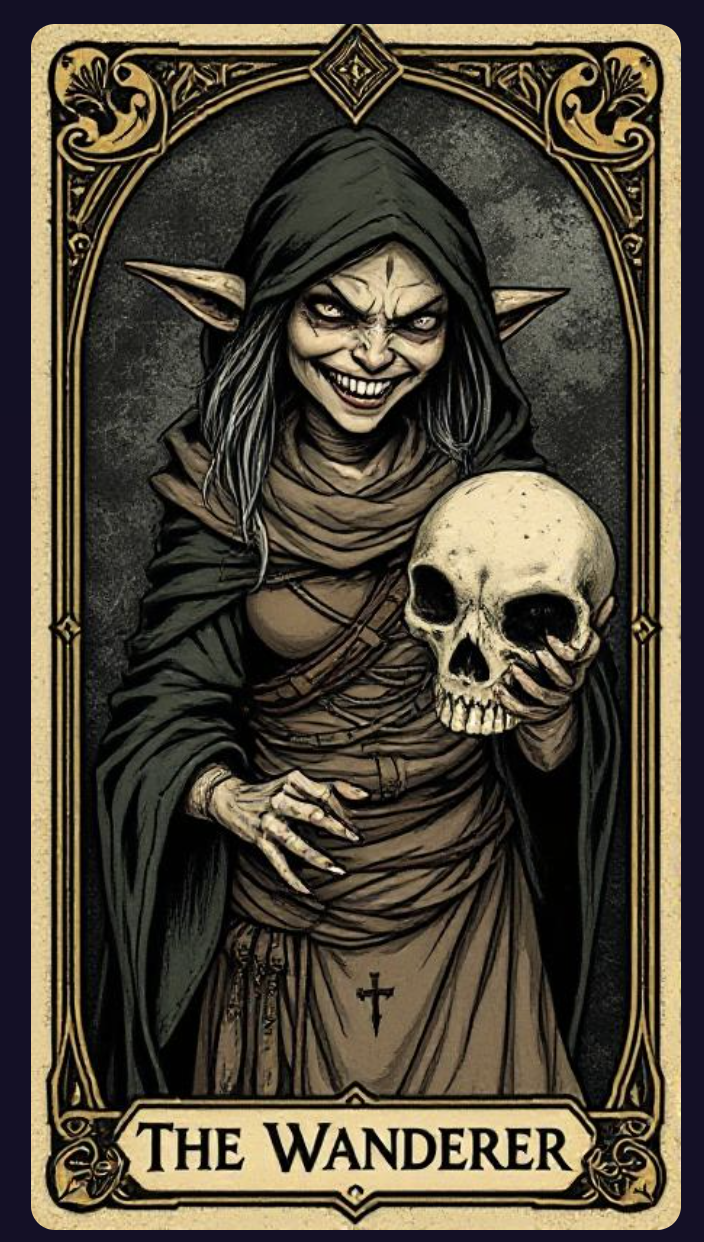
While in Egorian, a Harrow reader gave her “The Wanderer” card and told her to “Answer the Call” in Breachill on the 1st of Arodus. She spent weeks traveling alone through the wilderness, relying on her newly freed plant familiar, “Ouch,” for safety. After avoiding the city of Logas—where they hung goblin corpses on the walls—and surviving encounters with caravans and wild animals, she arrived in Breachill just in time to answer her destiny.

Kyira, Half-Elf Female Inquisitor of Milani

Kyira was born in Iadara to a human mother and elven father, already setting her life on a course of navigating between choices, loyalties to one lineage or the other, between sweeping world views and philosophies, as the elves of Kyonin and the humans of Iadara might as well be from different planets sometimes.

Among the many experiences that shaped the course of her life, however, nothing impacted her quite so much as her time in Steyr. She and her mother had been there only to visit the merchants and artists her mother loved so much. Kyira loved hearing all the tales the traveling bards told to their captivated audiences, too. But among all the travelers that congregated there were throngs of refugees from Galt whose presence in town was for more desperate reasons, having been torn from their homes and former lives, struggling to figure out how to rebuild and relocate.

Kyira’s eyes and heart were opened in many ways on that trip as she heard those stories, more than the bard’s tales of adventure and mystery. These were real. These mattered. These were people whose lives were being torn apart by uncaring rulers or petty brigands, and someone needed to do something about this!

Listening to their stories about their flight to safety, she realized that they were put into undue danger because they avoided taking a route through Kyonin, taking the more perilous routes through a fey forest to Tregan instead. But getting Kyonin to agree to allow them through (we won’t entertain the idea of accepting the refugees into the nation, of course) easily would take so long to get through elven isolationist bureaucracy as to not be worth bothering.

She let those thoughts eat at her for a while, and often discussed them with a close friend of hers in the hours they spent together discussing the problems of the world when she was in Iadara. Recently, she had been saying to Kyira that the obvious solution was to take people through Kyonin anyway, without the elves’ approval or knowledge if necessary.

And then it happened. Her friend just disappeared forever.

Worried and heartbroken, Kyira set about investigating until she discovered that she had joined a loosely affiliated group of freedom fighters known as “Firebrands,” and had set about actually working to smuggle refugees just as they had talked about. She was actually doing something to help people while I was just talking about it!

And apparently someone took notice and put a stop to her.  Kyira couldn’t let that stand. Her drive to find evidence of her friend’s fate and the activities of the Firebrands led her into the service of Milani and into a little Firebrand cell of her own. But that’s a story of its own to tell.

She spent only a month in Gath working with the Firebrands to smuggle refugees but she realized they had done more for Galt in that one month than any court decree had done in decades. This galvanized her to trust her own sense of justice, following in the footsteps of her deity’s own example, opting to take direct action where long, corruptible diplomacy so often fails to save individuals.

As a young Inquisitor of Milani, she and her small band were helping a small group through Kyonin and onto a ship down the Sellen when she had a chance meeting with the old woman.

She was among the refugee group, or at least Kyira thought she must have been, but she couldn’t recall quite if or when she remembered seeing her on the overland trip through the elven kingdom. She was sure she remembered the old woman’s form hobbling along with the group, but now, on the ship, as she sat below deck at the little table with her, something was different about her eyes, that seemed to penetrate unnervingly into her soul as she looked at her.

“You look to me as someone at the crossroads of fate who needs a reading, my dear,” she said. It wasn’t a question, nor a request. More of a matter-of-fact statement.

“I—”

“You’re about to tell me you have your life all figured out? Don’t be ridiculous, young lady. Sit still. Have you ever had a harrowing? Don’t listen to all the nonsense that some people will tell you who just try to win a silver from you, they don’t alter your future or tell you who you’ll marry, although some swear they have had better luck after a reading. But if you pay attention, you can learn much about events to come, fates, and the will of the gods, if you follow a god who cares enough to pay attention in the lives of mortals, that is,” she adds with a glance at the rose insignia on Kyira’s leather armor.

Unsure where this was going, she nonetheless sat for the fortune teller’s act. What could be the harm? she thought.

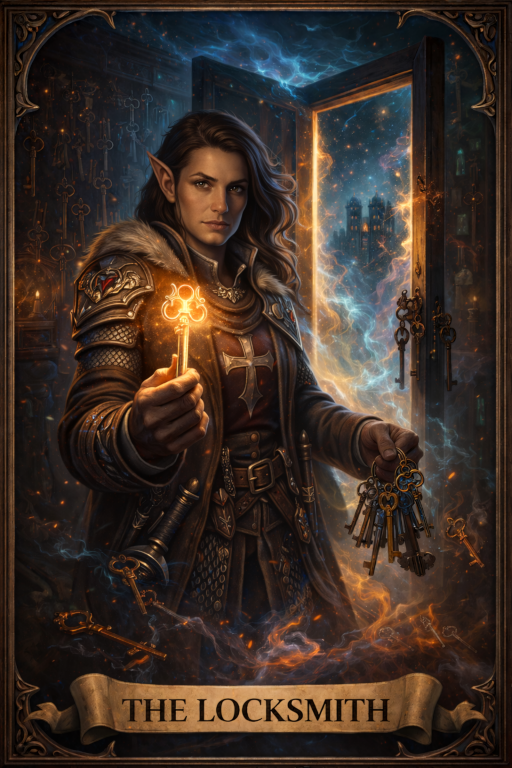
As the woman dealt out the configuration of cards, Kyira’s eyes widened slightly at the sight of their faces. She had never seen a deck decorated like these were. The images were unusual, even somewhat exotic. Detailed in what each card depicted in ways most decks were vague or symbolic. She hadn’t often given much heed to divination but had played more than her share of card games with harrowing decks to be familiar with the usual images. She was too distracted by the stunningly unique artwork that she didn’t heard anything the woman said about the reading until she turned over one card: The Locksmith.

Kyira gasped.

“Oh, that one calls to you, I see. Yes, sometimes that happens, that a card resonates with one for some reason, it speaks to us personally. Perhaps it’s tied to that person’s fate, past life, or something they need to resolve in their life. Did you lose a key belonging to your mother and need to return it, perhaps?”

Kyira was just staring at the card. Normally, harrowing decks showed a rogue holding a key, but this one depicted a half-elf dressed more like… well, more like an inquisitor, staring directly back at her, holding a key in her hand. Behind the half-elf on the card’s face was an open door revealing some mysterious place beyond. She finally found her voice. “What am I looking at? What does this mean?”

The old woman paused a moment that felt like the weight of eternity before she answered. “Only you can ultimately answer that, but this card signifies the unlocking of hidden knowledge. The keys and door are metaphors of course, for something hidden, something to seek, to learn, to unlock. But,” she pauses, looking over the other cards in the spread that Kyira had completely ignored, “given the context I’d say there are hidden secrets that something dark is seeking, or which may come out into the open and fall into dark hands. This card represents that whomever holds the ‘key’ to that secret controls that, and can use it for good or for evil. Perhaps it lies to you and your friends to find that ‘key’ before the wrong people do?”

“I have never seen any deck like this before. Where did you get it from?”

“You never will again, it’s one of a kind. It has a history, but even I don’t know all of it for sure. The man I bought it from claimed it was traded from Isger. Said it once belonged to a Hellknight that used to be stationed over there in the foothills of the Five Kings Mountains. Probably confiscated it from someone he arrested, truth be told, but the hellknights are long gone from those parts now, just the little town of Breachill is still there. There might be someone there who knows more about its history if you are that curious. But you’re not the first person I’ve seen have a reaction like that, and since my fortunetelling days are limited now, I’ve made a habit of gifting the card when that happens, makes for a few cards short in this deck, but no matter. Here,” she said, handing Kyira the Locksmith card to keep.

Lost in thought, Kyira considered all of this for some time while looking at the card, wondering at her decision to travel to this far-away remote town just to find out why she felt so drawn by the pull of fate. Was she imagining things? Or was this a prompting from Milani to act when action was needed? There was something beguiling about that card, and the thought of whatever mysterious secret it referred to landing in the hands of those who could use it to oppress more was unthinkable. Even so, it wasn’t much of a clue to go on.

For the rest of the voyage with the refugees, the old woman never acknowledged their conversation, and that strange light was gone from her eyes. She seemed the same nondescript old woman she had been during their trip through Kyonin.

It would be quite some act of faith indeed to make her way to Isger, and all the way to the little town of Breachill to see if this fortune teller’s “foretelling” led her to some clarity about her next step from there.

Tarsius, Male Human Warpriest of Nethys

Since he could remember, Tarsius just seemed to find himself in the right place at the right time.  There was plenty of activity in the old capital of Logas, so maybe it was not all that strange to have odd little things happen.

Odd, at least at first. Oh, it was pretty small stuff, like happening to be right next to his father when he found a coin on the ground.  His father said, with a smile, “you take it, son.”  It was being chosen to represent his school at the regionals over his chief rival, Axios.  But it was hard not to notice that, as he got older, his luck seemed to grow too.

It was having an old branch fall off a tree in a strong wind, but being able to push his buddy out of the way before he got clobbered in the noggin.

It was finding the leak in the barrel when he offered to help the barkeep unload a few casks of ale – it would have been emptied into the ground by the next day had he not noticed.

It was deciding on the spur of the moment to take a leisurely walk through the countryside and coming across someone who’d been thrown from his horse, unconscious and bleeding badly.  The rider could well have died if Tarsius had not found him when he did.

It was finding the tiny piles of sawdust that heralded a new termite colony out by the stable – a colony which, had it gone undiscovered, could have weakened the old structure to the point of collapse.

It was Fate, right?

Sometimes at the end of the week, when the work was done but the sun was still up, his grandfather would go to one particular trunk, carefully move some neatly folded clothes and pull out a tarnished old sword wrapped reverently in well-worn linens.  He would hand Tarsius a stout stick, and have mock sword fights with him.  Tarsius could always see the attack coming from the old man, and he would grin and deftly parry. His grandfather would always look surprised and laugh with him.  “You are getting good at this!” he would remark.

After maybe thirty minutes of this, his grandfather would grandly pronounce him “Champion of the Order of the Stick,” carefully rewrap the sword and put it away at the bottom of the chest, neatly stacking clean clothes over it again.  It was a ritual that Tarsius enjoyed. “Perhaps someday,” the old man would say, “we shall switch roles.”

Every attack, he saw coming.  It was Youth and Speed, right?

But although these moments of good fortune were sparse at first, they grew in frequency as he got older.  And it got him thinking: was it really Fate and Youth and Speed?  Perhaps it wasn’t any of those things – weren’t all of these events taken together a bit of a coincidence? Actually, a really big coincidence?

These questions finally caused him to seek out the wisdom of several local priests.  Several, because it turns out they all had different explanations.  One told him his experiences lined up perfectly with the writing of some prophet 400 years earlier, and that he should beware the three legged newt.  Another told him these events were clear signs that the mythical Runelords were returning. A third suggested he might be able to see its meaning more clearly if 5 gp were donated to his church.

In the end, he felt the most harmony with the cleric of Nethys.  The cleric he spoke with reminded him that without Tarsius’ intercession, these people would have been worse off. His intervention did not make anybody fabulously wealthy, but it did divert misfortune.  It kept things balanced.  Since no mortal could possess that kind of foresight naturally, it followed that it was a divine intervention.  Nethys was a god that strove constantly to correct unbalance in the world, but even gods have to prioritize.  While Nethys was dealing with monsoons and droughts, he used other mortals to handle “the small stuff.” Now that he was aware of this, the cleric said, Tarsius was at a decision point.  Did he want to continue to be Nethys’ tool? Or did he want to stop waiting for the world to come to him, and instead go meet the world?

Tarsius had not planned to be an instrument of the gods. He wasn’t sure he wanted to be, either.  (Who does?) And yet, if a god was selecting him in any way to manifest that god’s influence in the world … Tarsius shook his head.  That’s a big deal.

He gave it considerable thought.  Given all that had passed in his life, he concluded that Nethys, the god of Magic, was preparing to use him for something big. Nethys would make sure he was always in the right place at the right time, but once there he needed to be ready. He needed to both learn more of the church, and also more of how to defend himself against agents of discord and imbalance.

On Neth 21 4716, (the date of the balanced, half dark/half light moon of the month of Neth) Tarsius formally started his training to become a cleric of Nethys.

As part of his training, he learned that the task(s) Nethys has in mind for him would require him not just to be ready to channel divine energies but to also be adept in his use of weapons.  He learned how to properly handle many different weapons, but he found himself working most with  the longbow and a sword.  His teachers desperately wanted him to work with a quarterstaff, as that was Nethys’ favored weapon, but remembering the bouts with his grandfather, he couldn’t ignore his desire to distance himself from “the stick”. During his training, his teachers noticed he continued to have remarkable luck – once, for instance, an errant arrow from another student streaked by his ear and impaled itself in the tree next to him instead of giving him a new hole in his head.

Fate, they said.  Lucky, they murmured.  Still.  But by now, Tarsius knew differently. Nethys had something else in mind.

A mere two years later – a full year sooner than most – Tarsius was granted his vestments.  He was now a rather green (yet well-trained) warpriest of Nethys.  His parents were proud, but it was his grandfather who took this opportunity to lead him once again to the chest.  He pulled out the familiar sword but this time when he unwrapped the sword, it gleamed and shone.  “I polished it up a little,” his grandfather admitted.  “This was my father’s scimitar.  He was a warrior, as was I when I was younger.  Your father never showed an interest in learning how to use it, and I despaired that my legacy would not be passed on. But here you are, all trained and eager to provide balance to the world.  It seems appropriate to give it to you now.  It is a cold steel scimitar, masterfully made. It is particularly effective against demons and fey, which you seem far more likely to trip over now than I.  I think you will find it more useful than that stout stick they gave you.”

“Quarterstaff,” murmured Tarsius, and in a flash he realized his interest in learning to wield a sword was again, no coincidence. “You have had plenty of practice with a stout stick,” chuckled the old man, “but I think you’ll find this sword does better.” Tarsius nodded. “I am not a follower of Nethys, but I will still pray he watches over you.”

As he took up the sword, a small piece of paper fell from the linens and caught Tarsius’ sharp eye. “What’s that?” His grandfather leaned over and picked it up, scowling. “All the times I unwrapped this sword and I’ve never seen this before.  Hmmmm. It’s a harrow card.”

“What’s a harrow card?” asked Tarsius.

“It is said they can be used to tell one’s Fate,” he said. “There’s usually a whole deck of them, and using them properly is a skill in its own right. This one is The Keep, a symbol of strength.” He handed it to Tarsius. “I’ve seen more than one harrow deck, but I don’t believe I’ve ever seen a version with these stylings.”

Tarsius inspected it closely. “There’s some old writing on it. Says …” He squinted a bit. “Says ‘Breachill 30 Era’.”  He paused.  “30 Erastus?  That’s either a date long missed, or a date almost a year away.  What’s Breachill?”

“It’s a town at the far east of Isger, up in the mountains near the headwaters of the Conerica,” said his grandfather, scowling.  “I know it only from maps. It’s no small journey.  I myself have never been there. I doubt anyone in our family has been.”  He stared at the card. “There is no reason for that card to be in this place.  I’ve no idea how it came to be here.”

Tarsius looked at his grandfather. “Nethys,” he said simply.  “Nethys is making sure I am again in the right place at the right time.  I believe I need to make a journey.”

“That’s quite a journey to satisfy a hunch,” said his grandfather slowly.

“Not a ‘hunch’,” replied Tarsius. “It is a sign from Nethys to be in a certain place at a certain time.” He looked somber for a moment before adding, “I would be remiss in my new duties were I to ignore the call.”

Gath’gan Ianus, Male Human Slayer

Mid Lamashan, 4708

In the wilds, south of Haugin’s Ear

The dull thud of his head hitting something hard brought Ianus fully awake. He forced his eyes open and found he was on his back looking straight up. Naked tree limbs moved against a grey sky in a stiff but eerily silent wind. He turned his head slightly to one side. Brown, yellow, and orange leaves slid past. His head hurt and his left ankle seemed to be caught on something that tugged his leg.

He closed his eyes and calmed his breathing, and using all of the patience his six years could muster he listened. At first the only sound he heard was the scratching of the brittle dead leaves that blew past him. And then crunching. Something was walking through the leaves. Something close by. Something near his feet. He opened his eyes and looked toward his toes and saw a blurry figure walking away from him — walking but not getting any further away. It was holding something in its left hand.

Ianus pulled on his leg to free his ankle. The arm of the figure jerked back suddenly and the creature swiftly turned about and chattered angrily at him. Its mouth was filled with lots of small sharp teeth. He quit struggling and the creature turned back and resumed walking. And the leaves began to move again in time to the steady crunch, crunch, crunch of its steps.

“Oh!” thought Ianus, but then his head thunked hard against a very large rock and darkness took him.

Natre Mossdreamer grumbled softly to herself has she dragged her burden across the forest floor. “It is good. It is gift. Hanspur reward for loyal Natre.”

She was a stranger in these parts, but her sense of smell told her to give the woods a wide berth. Something large and hungry lived in there. She could feel that violence had happened nearby and quite recently. Still, she reasoned, if the beast had just fed then surely it was safe for her to quickly look for anything its prey might have dropped.

Greed and caution had briefly warred with one another before she considered what her patron deity would do. “Hanspur would not let such an opportunity go by.” And so she had plunged into the woods, letting her nose guide her.

Natre had been disappointed when she found the site of the encounter. Blood had been spilled — she recognized both human and something bear-like — but they humans had apparently escaped and the creature had run off deeper into the forest. “Ringworms,” she cursed, “this is wasted morning!”

She kicked a rock in frustration which skittered across the ground and then suddenly dropped out of sight. She heard it bouncing between hidden rock walls. She scrambled over and peered into a crevice only a few feet wide. Something was down there in the dark that didn’t belong. Maybe something worth retrieving.

Fallen twigs and leaves covered most of the fissure, making it nearly invisible, and it took much of Natre’s skill to safely follow it westward. The land fell steadily and after a few hundred yards she was able to safely jump into the now shallow crack and work her way back in the dim light.

She sniffed and poked and prodded the still form. “It be a human cub and it still breathes,” she said, delighted with her discovery. “Natre founds it and so Natre now owns it! Hanspur wills it so.”

Still she had a feeling that the fleeing humans might return to look for it, and so she drug the child from the chasm and was worked at putting as much distance between it and herself as quickly as she could manage.

Once out of the wood she paused and built a crude travois from some small branches and a blanket. Afterward she came upon an animal trail that led along the River Keld. The trail widened into a footpath that undoubtedly led toward Haugin’s Ear. She had come that way on her journey out, and knew she could cross the river there and make her way back home to the Chitterwood. But how would she explain the human youngling to the townsfolk?

Early Abadius, 4709

The Chitterwood (near Umok)

“Ga, ka, kaga, aath, kaas, kron, hirot, kaath, gath’mokaas, mokaas.”

Ianus beamed proudly at the goblin woman as he completed his recitation. The two were sitting around the fire pit in the main room of her hut. It was deep winter, snow covered the ground, and it was cold even inside.

She simply stared at him blankly and so he added, “I got them in the right order this time, didn’t I sora?”

“Oh! Boy count to ten rightly after only two months try. He some skai golin!” Natre replied with contempt. “You want I bake you cake?”

“That’s not fair,” he replied, “I know lots of other goblin words… uh, volaar.”

“You slow. Not learn fast enough. How I show you to tribe when you not speak right? From now on you spend more time with speech and less time at hunt!”

Ianus frowned but, wisely remained silent. Who would have thought that learning a new language would be so hard? And it was so much more fun to be outside, stalking woodland creatures with his shortbow.

Late Abadius, 4709

The Chitterwood (near Umok)

It was bitter cold outside and the blaze inside her hut barely kept the room above freezing. The fire-pit had never held so much wood before and she had already gone through half of her stored wood for the winter.

In a corner on the cot (her cot) beneath every blanket and fur Natre owned the small form shivered but was otherwise unresponsive.

A gnome stood beside the cot with its case of chemicals and reagents open as he muttered and mixed some elixir.

Yesterday Natre had walked to gnomish town of Umok through the heavy snow to find a healer. The human boy had been sick for a fortnight and despite her ministrations every day had seen it get sicker and weaker. She found the healer’s house but he was out. His wife assured Natre he would come to her place the next day after the snow had passed.

Pleghelwin came before lunch to find the fire blazing and the child bundled in the cot. Fortunately he had arrived in time and knew what the child needed.

“You fix? You heal?” Natre asked in her halting gnomish.

“Yes, I will give the boy a drought now and then you must do so again for the next three days.”

Later  Ianus would only remember a seemingly endless dream of darkness, screams, a giant bear, and falling.

Early Sarenith, 4714

Saringallow

“And so it’s 25 gold pieces for each of these potions of the highest quality, brewed in the Chitterwood by local crafters. It is quite a deal and you’ll get nothing but compliments from your clients who use them.” Ianus Gath’gan smiled at the merchant, trying not to show too many teeth. Still, he was aware that his smile did not always convey the emotions he wanted to show.

The man behind the desk looked over the crate of carefully packed potions and eyed him, noting just how young he was. He decided to try to low-ball the offer. “Made by Goblins, you mean. I am not sure I should pay you that much. How about I pay 20 per vial? That’s plenty generous.”

Gath sighed inwardly but hoped he didn’t show his frustration. This was the usual treatment he received from new merchants, which was why he preferred to trade in the towns and villages immediately surrounding his home in the Chitterwood. Those merchants knew him and didn’t try to pull this sort of crap. But the local tribe had decided that the markets in the nearby villages were saturated and that they were not buying enough merchandise, which meant traveling further from home and breaking in new shopkeepers — or “establishing business contacts,” as normal tradesmen would put it.

He decided to fall back on his usual tactic when dealing with the uninitiated. “Hmm, well I am not authorized to accept that large of a discount. Why don’t I go and bring my clients here so you can discuss it directly with them. It looks like there is space for a dozen or so goblins in here.”

“Ah…” the merchant began to back pedal. Gath knew that the shop’s inventory was low and his position was strong. That morning in the pub he heard about a band of explorer types that had passed through some days before and had depleted the shops of their adventuring supplies.

Gath pressed his advantage, “It’s no trouble, I assure you. They are encamped just outside of town and I am sure they won’t be put out at all by having their lunch interrupted to come and discuss why they shouldn’t be paid a fair market value for their products.”

A band of sweat was forming on the shopkeeper’s head as he quickly said, “Now that I think of it I do recall hearing about the quality of Chitterwood potions. I am sure they are worth the er, um, 23…” Gath squinted and by tilting his head back managed to glare down at the merchant, who physically towered above him. “Uh, right, 25 gold pieces per potion.”

“Deal!” cried Gath. “Dee-lighted to do business with you.”

He collected the payment and after counting it left the shop with a parting, “We’ll see you again in a couple of months then.”

He breathed a sigh of relief: he had sold the last of the tribe’s stock and he could return to the camp, which in reality only had two goblins: Natre and Vlaung. He could take his fee and maybe do some shopping of his own before they left for home.

Gath was not a very good trader and the best he usually got was just market value — no matter how desperate the local merchants seemed to be. But compared to how the goblins did on their own he was effectively a master at the craft, and so the local tribe insisted he handle all of their dealings with others.

Of course Gath was not a member of the tribe (he wasn’t a goblin, after all), but his guardian, Natre, who was a goblin (but also not part of the tribe) insisted he accept this role.

“It was goblin kind that raised you and so you owe goblins this,” Natre kept reminding him.

“Actually,” he would reply, “It was you who raised me and prevented the others from eating me. You do remember how I came by my name, right?” Gath’s full name was Gath’gan, which in goblin tongue literally meant “Don’t eat,” which was how Natre had introduced him to the tribe.

“You be much thankful Natre stopped goblins from eating you when you was smaller! Where you be without me?”

And to that Gath had no answer. He had no memories of his life before Natre beyond a vague dream-like trip through an autumn wood when he was quite small.

Mid Arodus, 4716

The Chitterwood (near Umok)

“See, this type bow better than simple bow you use. You bow single piece of yew — easy to make and good enough for most hunts. This bow made from different woods. Take advantage of different tree hearts. It shoot farther and pierce deeper.”

Natre knew a lot about bows, and making them was one of the things she did for the local tribe — her former tribe. Why she was no longer a member and why she lived alone with only Gath for company she never explained. She had taught Gath how to make simple shortbows (for goblins) and longbows (for selling), but now she was teaching him the complex steps needed to craft a composite bow.

Goblins typically didn’t care for this type of bow, but now that she had someone tall enough and strong enough to help (and test) a heftier weapon she wanted to sell them to humans in the villages around Chitterwood. Longbows fetched a reasonable price in town, but apparently composite longbows demanded much more.

Of course there was more work and skill involved with building a composite bow, but she had free labor in Gath, and he was more than skilled enough for the precision work required. And he enjoyed it.

Early Gozran, 4718

The Chitterwood (near the Voghul Caverns)

“As usual Natre got her way,” Gath mumbled beneath his breath. He was perched atop a promontory with the rest of his team while watching for their quarry to arrive at the planned ambush site.

The goblin tribe’s main settlement had been invaded several times over the past few weeks by large boars. They left huts flattened, goblins trampled, and worst of all, food taken. The chief had demanded his warriors take action, and action they took. On their first foray they forgot what they were tracking and returned to the village proudly bearing the corpses of numerous squirrels, rabbits, and starlings. Two days later they managed to remain focused on the tracks long enough to find the pack of tuskers, but had no plan for dealing with them. Two were gored to death and most of the others injured before they limped back home.

Natre heard of this and insisted that Gath lead a hunting group out to find and slay the marauding pigs. “You better hunter. You better warrior. You lead tribe to victory over pigs.” But most importantly she had said, “Remember Natre and bring back shoulder and belly.” This she repeated several times.

It turned out that she had failed to tell the goblins about her plan, and Gath was in no mood to argue the point when he arrived in the settlement ready to lead a team of warriors on the hunt. Fortunately (or unfortunately from Gath’s perspective) the chief sided with Gath and assigned six of his “best” fighters to accompany him.

The tracks were easy to follow even days later. No other animal seemed to delight in trampling and rooting up the ground like boars. The pack had moved further into the Chitterwood and it took several days to catch up to them. The pigs had found a bog in which they wallowed and slept.

To the south Garth had noticed low limestone hills not too far away. He left his squad hiding in a thicket after reminding them that they needed to be quiet. The ground turned rocky and sloped upward. He found a wide cleft in the rock that natural forces had carved into the hills about a furlong in length. The surrounding rock rose higher and higher on either side and at the end the crack squeezed shut in impassable walls. “Perfect,” Gath said to himself, “Now to explain my plan to the thickies.”

His plan was simple: set up a dead-fall of branches and boulders at a narrow spot in the ravine where the walls closed in and lure the boars in. They team could then seal off the entrance and trap the pigs within. After that they could pick off the porcines at their leisure using spears, arrows and rocks. It was a simple plan and even the goblins seemed to understand it.

“And here is the best part,” Gath explained to the goblins, “one of you — the chosen one — gets to slather himself with the rancid sheep fat we brought along and lure the boars into our trap. We will have a knotted rope tied and ready at the far end of the crack to serve as an escape. Of course we can only have the fastest, strongest and bravest warrior take on this important task.”

The result was sadly predictable and the goblins quickly came to blows over who was the most deserving of this honor. Gath had to step in to settle things before someone was killed. “Clearly each of you has some special talent or skill that makes you a good candidate. The only fair way to chose the prime warrior” — Gath’s public name for the role he privately called the bait“is to let Hanspur decide.” In short order five goblins glumly held short pieces of grass while the sixth proudly held forth the long piece and gloated.

As the five sullen goblins made their way to the fissure’s entrance Gath handed the bait a worn pair of boots. “Your chief loaned these to me for the hunt, Hansire’s champion, and so it is fitting that you should wear them. Once you have the boars’ attention and you begin to run, activate them and they will help speed you to safety.”

Gath was a bit worried his instructions were too long and had too many syllables, but the warrior nodded sagely and so Gath trusted he understood. “Watch for the flaming arrow and when you see it bring the pigs to us!”

The plan worked surprisingly well. Actually, really, phenomenally well. The bait lured all of the boars into the narrow canyon, Gath and the other goblins sealed them in by dropping boulders and logs at the choke point. And all of the beasts had been slain. The only thing to go wrong was that the bait was unable to climb the rope fast enough (the rancid sheep fat made his hands too slippery) and he had been gored and trampled to death. The other goblins didn’t mind, and in fact seemed a little pleased because he had been so annoyingly smug about his role as the chosen one.

They hauled out the bodies and buried the goblin beneath a pile of rocks. The pigs were butchered and the meat smoked in makeshift racks set next to low fires. Some of the goblins objected to this, but Gath had no intention of traveling for days with spoiled pork in his pack (and surrounded by others with the same) and so he held firm. His reputation from the successful hunt carried the day and so smoked meat it was.

They returned several days later as heroes. The goblin hunters were called “the fearless five” (nobody had asked about the missing sixth) and even Gath was looked upon with respect for some time.

“And most bestly,” Natre said, smacking her lips as she chewed a greasy piece of pork belly while Gath recounted the hunt, “you bring back pig meat.”

Late Neth, 4718

The Chitterwood (near Umok)

Gath left the goblin village after completing the circuit of their usual market towns. People tended to not travel in the cold months and so trade had been slow and profits less than usual. The goblins, of course, blamed him.

His thoughts turned to home and of Natre. She had not gone on this trip nor any of the trips this year, citing aches and pains as the reason. He couldn’t blame her: it was cold and ice hung from the trees and the wind cut right through even the thickest clothing. And the trade circuit had expanded to take nearly a fortnight.

A new thought struck him then that stopped him dead in his tracks. “Just how old was Natre?” She wasn’t young back when he first came to her and many years had passed since then. In fact he could not think of a single goblin from the tribe whom he had known back in his early days among them who was still alive.

The hairs on the back of his neck stood on end and picked up his pace.

There was no smoke rising from the round hut’s central vent hole. Not a good sign.

“Natre!” he called as he pushed open the door. There she was, lying in her cot. Face up. Fully dressed in her “nice clothes” with her arms across her chest. A necklace had been placed around her neck and a bow laid at her side. She was dead.

Someone had been there since she had passed and seen to her. One or more of the goblins from the tribe. Gath appreciated that. It was a sign of great respect for the goblins to do anything for their fallen, much less an outsider like Natre.

But then he realized that all of her valuables were missing. Even the secret stash of coins she kept in a hole beneath a flat rock was gone. Anger briefly blazed in his heart. “Thieves!” he spat.

He pulled the small stool next to the cot and sat by his guardian’s still form. The anger slipped away and he once again thought of the care and respect the goblins had shown Natre.

“Goblins will be goblins,” he thought, “and honestly we would have done the same given the circumstances.”

Some hours later he considered his own situation. Natre’s place had truly been picked clean: there wasn’t a pot or scrap of food or even twig of firewood left. All he had were the clothes he carried with him, some leather armor Natre had stitched together for him, his bow and a dog slicer. He did have some gold from the most recent trade run.

What to do? He could not see trying to continue his life with the goblins. Not without Natre. But it was winter and a bad time to wander in search of a new home… and a new career. But he did not want to spend the rest of the winter living in the hut haunted with memories of his old life. One more night he would spend. Sitting next to Natre in respect.

The next morning flames and smoke engulfed the hut. Gath had filled it with fallen branches, twigs and leaves and set fire to it.

He set out headed towards the town of Umok. “I hope I can find someone in need of a hired hand. And I can still craft bows to sell. And it is the perfect chance to improve my gnomish.”

He was convinced that in the new year he would leave the Chitterwood for good and forge a new life.

Aemi Salinas (Sura), Human Female Bard (Duettist)

Part 1

Aemi grew up in the minor noble House Sura in Kerse, the capital city of Druma. Her paternal grandmother, Euphema, had a reputation for wisdom and careful judgment, and was widely respected among the city’s merchants and minor nobility. Her grandfather, Mercus, had built the family’s standing from modest beginnings through successful trade and careful investments. When they died unexpectedly, their only son and Aemi’s father, Quaris, inherited their estate.

Quaris moved his family into the manor when Aemi was eight years old. His parents had left behind a respectable inheritance: the house itself, a modest reserve of gold and liquid assets, and several steady sources of income tied to property and investments. For Aemi, Euphema had also established a trust intended to ensure that she would receive a proper education in the cosmopolitan city, with her parents named as its trustees.

But while Quaris inherited the estate, he did not inherit the instincts that had built it. Over the following years the family’s finances began to unravel. At first the problem was simple enough: they spent more than they brought in. But Quaris tried to solve it by chasing new income rather than tightening their spending. He poured money into increasingly risky ventures, and those that were not ill-conceived to begin with faltered under his poor management.

As Aemi grew older, the signs of strain became impossible to miss. The staff was slowly shrinking in size, items were wearing out or breaking without being repaired, the grounds were deteriorating as caretakers were dismissed, and so on. By the time she was fifteen, the manor had developed a shabby appearance, and she could see more clearly the differences between her own standard of living and those of her friends—especially when she visited their homes.

And then there were the fights. At first they had been muffled arguments behind closed doors, but over time even that pretense disappeared, and they grew louder, and more frequent.

During one particularly bitter argument, Quaris accused Verana of stealing from him. The accusation struck Aemi as absurd. Their troubles were plainly the result of his own mismanagement, not some conspiracy involving his wife, and besides, their assets were shared by law. The idea that Verana could somehow steal from him felt less like a claim and more like desperation.

Aemi’s only escape from the chaos at home was the Kerse Conservatory of Music, where she enrolled at the age of eighteen. For a time it offered distance from the tensions of the manor; distance enough that she could almost pretend they didn’t exist.

It didn’t last.

In her second year, her mother appeared at Aemi’s student suite and said to her, “I’m leaving your father. I hope you understand.”

The only thing Aemi didn’t understand was why it had taken so long, but when she asked, “Will you be all right, financially?” she learned a shocking truth.

Her mother had seen the decline of the household years earlier, long before Aemi reached her teens. Unwilling to watch her life collapse alongside it, Verana had spent that time quietly skimming money from the family accounts and placing it into a private reserve for the day she would leave.

The revelation left Aemi stunned. Years of quiet deception sat uneasily beside the image she had always held of her mother. Verana, however, spoke of it as though it were the most practical decision in the world. When she asked Aemi to withdraw from the Conservatory and leave Kerse with her, the request felt less like an invitation and more like the final step in a plan that was years in the making.

Still reeling, Aemi refused.

This response touched off a bitter argument, and what began as disbelief quickly hardened into vitriol on both sides.

Fine,” Verana snapped at last, the word dripping with contempt. “Then you can stay here with your father.” 

She turned and left in a fury.

Aemi didn’t know it then, but that would be the last time she saw her mother.

When the term at the Conservatory ended, Aemi was informed that she would not be allowed to return because her tuition for the coming year had not been paid. Assuming some mistake had been made with the payments from her trust, she arranged a meeting with the trust’s protector. As the explanation unfolded, she could feel her life steadily unraveling. Years earlier, Euphema (believing she was making the responsible choice) had named Verana as sole trustee in the event the marriage dissolved.

Her own mother had modified the trust and assigned a new beneficiary.

Unwilling to live with her father as he spiraled into financial ruin, and even less willing to seek out her mother (assuming she could find her), Aemi was, for the first time in her life, completely on her own. With only her meager accounts and half-completed music education to support her.

Part 2

Aemi had three days to figure out what she would do next, as that was when the term ended and she’d be expected to move out of her suite. Three days to come up with a plan that would get her through the start of the rest of her life.

The first step was figuring out how long her money would last. She had only a vague understanding of what things cost, but she was resourceful and rather good with people, and motivated to learn. She visited flats, tenement buildings, flophouses, and communal lodges; markets, bazaars, dispensaries, tailors, general stores, and farm stalls. Two days later, sore and exhausted beyond all measure, she stumbled back into her room with a better understanding of where she stood.

Aemi considered the three lowest buckets of living conditions: “can make it work”, “only if necessary”, and “total desperation”. Without any source of income, her money would support her for six to seven months in Kerse, and up to twice that long, depending on how far she was willing to travel, and how much she was willing to compromise on her standards.

Living in Kerse was not an option for more than just financial reasons. She couldn’t go home–she couldn’t put herself through the shame and embarrassment of her family’s collapse–and staying in the city would just stretch out the humiliation. Eventually, someone, somewhere, would recognize her, and then the questions would come. And, besides, the city’s gossip rags found the Sura family’s fall from its noble heights a perpetual source of entertainment. It was hard enough to live through it (You mean “run away from it”, that voice in her head corrected; she ignored it), she didn’t want to be reading about it, too, especially when you never knew when the next column would print. So, travel it was.

On the third day, Aemi packed up her essentials, sold the ornate, ivory flute her parents had given her (and purchased a modest wooden flute to replace it–she wasn’t an animal), and walked out of her suite, leaving the rest of her belongings. She spoke to no one and left no message behind. She didn’t even shut the door. When the staff at the Conservatory checked on her that evening, it was as if she had simply disappeared.

Part 3

Five months and over 140 miles later, Aemi, now using the surname Salinus, arrived at the logging town of Macridi. Her coin had depleted faster than she had expected, and at the current pace she had, maybe, another three months before she would be forced to let go of “only if necessary” and fall back to “total desperation”.

Work had been difficult to come by. The cities and towns became progressively smaller as Aemi traveled the Profit’s Flow away from Kerse, and most had nothing for her, especially since she had little to offer in the way of skilled labor. She gave each stop a few days, sometimes weeks, looking for something more substantial than part-time menial labor, before giving up and moving on. The one job she managed to find that was well-suited to her was at the Torch Orchard as a sort of receptionist for visitors–mostly merchants and tourists–but it was just a temporary thing, lasting only a couple of months until the season changed. Even if it could have been something permanent, the “only if necessary” expenses in such an exclusive region were barely covered by her income, so she couldn’t stay there forever, anyway.

Aemi’s frustration, and sense of desperation, was steadily growing. She nursed a lot of anger at her parents during this time: at her dad for bringing financial ruin on them all, and at her mom both for the depths of her deception and for cutting off the trust out of spite. That Aemi’s own financial situation, at least the part where she was spending more than she was earning, now mirrored her father’s was just more fuel for that fire. And while the anger did wonders for her resolve, in the back of her mind there was this tinge of guilt for what she had done, and how she had done it. Acknowledging that guilt, though, was an unpleasant thought, and it threatened to release a floodgate of mixed emotions that were worse, so she buried it deep and focused on the future. Besides, she thought, it was too late to change anything now.

Macridi was the first significant settlement after the three-day journey through the heart of the Palakar Forest. The forest itself was home to three faerie courts, each with differing opinions on trespassing by outsiders, so settlements along the river were rarely more than small and transient logging camps. In contrast, Macridi had come to an accord with its neighbors, and by exercising restraint over its logging activities, the town was able to grow both its industry and its population. It was home to over 3,000 permanent residents and responsible for the choicest darkwood and paueliel in all of Druma. That restraint in the logging industry also carried over to other aspects of life in town: unlike those in most of the polity, Macridi’s residents did not find it necessary to flaunt their wealth. To Aemi, it felt like a real city, and one that wouldn’t pass judgment on her currently nomadic life.

It was also the first place Aemi found steady work. In the mornings, she was a civic scribe for the city, a somewhat thankless job that just happened to require the services of a person who was both erudite and articulate. In the evenings, she was a server at The Forest’s Drake, an upscale inn and tavern complete with a common room and stage. Serving food and drinks to (often times) drunk loggers and fighting off unwanted advances were items not high on her list–she had settled into “only if necessary” territory long ago–but seeing musical performances from both local and visiting musicians provided a connection that she felt she had been losing. There was also a more direct and personal benefit that her manager was kind enough to indulge: after closing, she would often take to that stage herself to play her flute or sing, granting a short, private performance to the rest of the weary staff.

She had been living there for over a year when a bard traveling from downriver passed through town. In addition to his musical performance, he shared news from the capital.

Aemi almost dropped her tray of ale-filled mugs when he announced that the now-disgraced noble Quaris Sura had hung himself.

Part 4

Aemi worked her shift half-distracted as she listened to the rest of the bard’s news. Thankfully, there was no mention of a daughter, much less a search for one, and she was finally able to relax once he was done. Her fingers and muscles ached. She had not been aware of how tense she was.

The bard was still there, talking with Erco, the Drake’s manager, as they closed down the common room. She just needed to clean the bar, and she’d be free to go home. There’d be no private performance tonight.

She was wiping the countertop dry when she heard the bard’s voice behind her. “I’m truly sorry about your father.”

She stiffened up for just a moment, then quickly resumed drying the counter with her cloth.

“You have me confused with someone else.”

“I’m not here to spill your secrets. If I wanted to cause trouble for you, I would have done it already; I wouldn’t be talking to you now.”

When she didn’t answer, he continued, “I assume you’re using a pseudonym. No one even looked at you when–”

He cut himself off as she turned to face him. He was a few years older than she was, and had the look of someone who spends a great deal of time on the road. It was a look she had come to know well. He met her gaze with hazel eyes.

A quick glance showed there was no one in earshot. She said, “I’m Aemi Salinus here.”

He nodded in understanding. “Smart. Though perhaps smarter to change your given name, as well.”

“I…couldn’t.”

He regarded her for a moment, then nodded again. “I understand.” He paused, then said, “They searched for you–”

“I don’t want to know,” she said sharply.

He held up his hands as an apologetic gesture. “I’m sorry. I shouldn’t have presumed.” He hesitated before adding, “And I’m not one to judge. Your choices are your business. If you’d rather I leave you alone…”

“No, it’s fine.”

He didn’t seem convinced, but then again, she didn’t sound very convincing. She added, “This is the first time I’ve spoken of it. And…you’re the first that’s known.”

He gave her a sad smile, acknowledging the difficulty without being patronizing. “We were in Kerse when…” he started, then thought better of it. He shook his head, saying, “I’m sorry. I’m being rude.” He bowed slightly to her and added, “Let’s start over. I’m Davio Helenus.”

She smiled in turn. “Davio. Thank you for your discretion.”

“Of course. The manager here says you play the flute, and that you have a lovely singing voice.”

Aemi blushed. “I…Yes. I’m not as accomplished–”

“I’d like to request a performance, if I may. He also said you sometimes do this for the staff here, after the room has closed.”

Aemi hesitated for a moment. She wanted to say “no” because the news about her father had hit her far harder than she was expecting. She wasn’t in the mood to play for anyone, much less someone she just met. One that already had her at a disadvantage. But something about the moment felt significant in a way she couldn’t put her finger on, and over the past year and a half she had learned to trust those instincts.

“OK. But just one song.”

She stepped up to the stage, pulling her familiar wooden flute from the deep pocket she’d sewn into her work clothes, breathed deeply to center herself, and began to play.

It was a melancholy tune, one she had learned during her second year at the Conservatory, and she leaned into that feeling, letting her unexpected grief flow through it. The piece was challenging but not difficult, and though she felt as if every mistake was magnified, she didn’t falter. Did not lose her composure. When she finished, the room was dead silent. One of the other servers, the barkeep, the cook, and of course, Erco, had come out to listen.

Then the applause came. Davio was smiling wide when he thanked her.

“I made so many mistakes,” she said.

“Small ones, only, and not as many as you think. It’s also a difficult piece, far harder than many realize until they try it. You have a real gift.”

She blushed again, and only said, “Thank you.”


The next evening, when she arrived at The Forest’s Drake for her shift, there was a wrapped package, long and narrow, waiting for her.

“He brought it in this morning,” Erco explained. “Just before he and his companions left.”

She pulled the cloth away to reveal an ornate wooden box. Inside was a beautiful flute of polished ebony, and attached to it was a hand-written note:

Play on.

-Davio

Part 5

The first few weeks after that evening were ones of mild apprehension and occasional sleepless nights, but Aemi finally concluded that Davio had been true to his word. No one came looking for her. No one confronted her over her name or her past. No one expressed any doubt or suspicion that she wasn’t anyone other than who she said she was.

No one got too close to her, either, but that was by her choosing. She had friends, but kept them at arm’s length. She had suitors, but politely declined them all. The fabrications about her past were a lot to manage, and the closer she got to someone the harder it became. The more it felt like a false intimacy. She had a whole history created for herself, one of humble beginnings–some half-truths taken from her childhood, some stolen from her childhood friends, others completely made up–including the events that led to her traveling alone along the Profit’s Flow. It was an enormous house of lies she’d built, and she took no chances with it.

Another year passed.

Her responsibilities as one of Macridi’s civic scribes had also grown over this time, and it now paid well enough that she didn’t need to work as a server in The Forest’s Drake. She did it anyway, though mostly just on weekends. She liked the people and the atmosphere too much to leave it behind. Erco had even persuaded her to perform for the patrons, not just the serving staff, as part of The Drake’s official entertainment. She agreed to take the stage two nights a month, and though she was not as talented as most of the traveling performers that passed through, she was one of their own.

For the first time since leaving Kerse she wasn’t worried about her future, but she admitted to herself that she was lonely. To solve that, she’d need to move on. Start fresh somewhere else, only this time as herself, not the person she had made up. It would be a big step, and one that she didn’t think she was quite ready for.

On a Starday night in early Rova, she had just finished a performance in The Drake, and when she stepped off the stage, she was shocked to see Davio beaming at her.

“A hug for an old friend?” he asked.

She laughed excitedly, and they embraced.

“Thank you for the flute!” she exclaimed. “It’s so beautiful. I still can’t believe you did that for me.”

“It was far less than you deserve,” he said. “Come! I want to introduce you to my companions.”

Part 6

His friends were seated at a round table towards the back of the room. Two humans–a man and woman of Chelaxian or Taldan descent, perhaps mixed with a bit of Kellid, both of whom had several years on her–and a dwarven man. On the table were four tankards–one presumably Davio’s–and the remains of a communal plate of bread and cheese. They looked up as Aemi and Davio approached.

The human man had a lithe, muscular frame and straight, black hair that came down to his shoulders. There was a casually dangerous look about him, and his relaxed posture belied someone who was keeping track of the room. The woman was equally slender and muscular, with wavy, brown hair tied back in a tail. The expression on her rounded face was more inviting. The dwarf was stocky and a wall of muscle, as dwarves in this area tended to be. His reddish-brown hair was so unkempt it looked like he wore a mop as a hat.

Davio did the introductions. “My friends, this is Aemi Salinus. Aemi, I’d like you to meet Janngu, Annet, and Volkhard,” indicating the human man, woman, and the dwarf.

The first two acknowledged her with a nod. Vokhard said, in a sonorous voice, “Ma’am. It is a pleasure.”

She greeted them in turn, and as Davio sat, he gestured towards the empty chair.

“What did I tell you?” he said to his companions. “She’s good, is she not?”

“You have a lovely voice,” Volkhard said.

Annet turned her head towards Davio, but glanced at Aemi as she spoke. “She’s good. But she’s inexperienced, and…a little young.”

“We were all young once,” Davio answered. “And we don’t need ‘experienced’, just ‘good’.”

Janngu just regarded her silently.

Aemi was uncomfortable. She felt like she was on display, being judged like a prize animal, and her expression hardened. “If this is how you introduce people to your friends,” she said sharply, “you can take your damned flute back.”

Janngu couldn’t suppress his laugh at this response. “Oh, she has got you figured out, Davio.”

She glared at him and started to get up.

“Wait. Please,” Janngu said, suddenly softening. “We apologize for being so rude. You’re right. This was no way to introduce ourselves. And a terrible way of…extending an opportunity to you.”

Davio, who was looking genuinely hurt by the earlier rebuke, smiled hopefully.

Aemi’s anger melted away, and now she was thoroughly lost. A what? She settled back into the chair. “I…I already have a job.”

Davio chuckled. “Please. You spend your days rewriting and editing letters. They value you for your penmanship and your grammar. On the weekends, you’re here, serving food and spirits to a bunch of drunken loggers who only see you from your thighs to your chest, and have a limited understanding of the word ‘no’. You should be up there,” he said, pointing to the stage with his thumb, “but you only do it twice a month.”

Aemi was stunned. “How…how do you know…?”

Volkhard snorted loudly, Annet rolled her eyes, and Janngu gave her a look that said Don’t be naive.

Davio ignored the question and continued. “Listen to me. You have real talent. And it is wasted here. Just…hear us out. Let us make this pitch to you, and we’ll give you some time to decide. We won’t coerce you, or pressure you. The choice is yours to make. Give us that much?”

Aemi thought it over and said. “OK. I’ll listen. What is this ‘opportunity’?”

All heads turned to Janngu. He said, “Let’s find somewhere private.”

Part 7

They entered the grounds of Kalistocrat Tronak’s estate mid-morning on horseback, pulling their covered wagon with “The Five Kings Minstrels” emblazoned in colorful lettering on its wooden side panels. The preparations for the Harvest Feast celebration were well under way, and various minstrels, troubadours, and wandering players that would make up the day’s entertainment were putting up tents on the grounds that were set aside for their camp. 

From the outside, Davio, Aemi, and Volkhard (who had a surprising talent for percussion instruments) were the minstrels, with Volkhard doubling as their guard when traveling. Janngu and Annet were the porters, and also kept watch over their tent.

On the inside? Well…


“So you and Annet are thieves,” Aemi said. It wasn’t a question or accusation.

“When it’s required of us,” Janngu replied. “For this, it is. We’re not asking you to steal. Just perform. Sing. Play your flute. Do what you’re good at.”

“You, me, Volkhard, our job is different,” Davio said. “We travel where Janngu and Annet ask us to go, and we perform there, and at stops along the way. They do their ‘business’. We are their transportation, and their cover.”


There were nine acts scheduled for the day, and somehow, Davio had managed to land them a coveted slot towards the end. “We were here last year and I made some…friends,” he explained. “And adding a bribe or two didn’t hurt.”

Last year had been a dry run of sorts. Today it was for real.

Annet had produced a copy of the staff schedule last night—Aemi knew better than to ask how she got it—and this late slot would be towards the end of a shift when, hopefully, those on duty were just a little more tired. Just a little more lax. Less likely to notice Janngu doing…well… whatever it was he’d be doing. Or to intervene if they did.


“And we won’t be stealing while we’re there. This whole charade helps me get into the manor quietly and then out again. Nothing more. All I need is half an hour,” Janngu said.

“And what will you do once you’re there?”

“Do you really want to know the answer to that question? Think carefully.”


When the minstrels ahead of them were finishing their act, Davio cast a spell to enhance Aemi’s performance. She had rarely had magic used on her, and never in this manner. It felt…strange. “I trust you completely,” he explained, “and you are good enough to do this. But. It’s your first performance before a large crowd, and you’re nervous. It will help you be confident in yourself. It will last long enough to get you through the anxiety.”

She nodded.

“Don’t get used to it,” Volkhard added. “We’re not making a habit of this.”

Annet wished her luck, and Aemi thanked her in return. Aemi was going to say something to Janngu, but he was suddenly nowhere to be seen. He was right there not half a minute ago; she hadn’t even seen him leave. How did he do that?

Davio broke her out of her rumination. “We’re up.”


“Why me? Why now?” Aemi asked.

“We had another with us, but they quit two months ago. Didn’t want this anymore. It’s hard on a person, spending so much time on the road, so we respect that decision,” Davio said. “As for you? You are good enough to perform with us. And, this life we lead…it works best if you have no ties.”

“Meaning, my father is dead, and my mother may as well be. My life here is built on lies.”

“That is a painfully blunt assessment. But, yes.”


When their act was over, Aemi barely remembered more than a jumble of images and emotions. The fear when she first took to the stage. How it melted away when they began to play. How comfortable she had become with the onyx flute. Being part of a whole, of something more than just herself. How the crowd listened intently as she sang. The applause afterwards. She finally understood what Dario meant that night in Macridi.

Annet and Janngu greeted them when they returned to the tent and said, quietly, “It’s done”.


“And when it’s over, then what? What happens to me?”

Janngu replied, “Then you have a choice. Come back to this life, maybe start a new one. That is enough money to buy you a few years to figure out what’s next.

“Or, you can join us.”

“And if you decide to stay with us,” Davio said, “I will teach you to do more with your gift than just play music. You’ll also get more than this pocket change. You’ll earn a share of the prize.”


The following night, she sat with Davio and his companions around the campfire and listened as they told her stories of their four years together. She realized she was looking at a family of sorts. Like her, they all had their secrets, but among each other, those secrets didn’t matter. They accepted one another for who they are now, not who they were or what brought them here. And they were inviting her in. All she had to do was step through the door.

When the last story was told and the silence fell over them, she looked into the fire for just a moment, watching it burn. Then, she said, “I’ll do it. I’ll stay.”

Part 8

It was three weeks’ travel from the Kalistocrat’s estate outside of Alabastrine to Elidir, stopping at inns along the way. Some nights all three performed, sometimes just one or two. They spent nearly two weeks in Elidir, proper, while Janngu and Annet conducted their business.

One night, on the road to the capital city, Aemi got brave enough to ask Annet when the job at the festival would truly be done. “Another month or so,” she answered. “We don’t want anyone to connect it to the festival, or us. And we need to meet with someone, first.”

It was, in fact, closer to two months. They had returned to Druma and were in the beautiful port city of Detmer when Janngu and Annet left. They were gone for four days, and when they returned, they carried with them a magical sack that was larger on the inside than out. Janngu emptied its contents on the bed. It was more platinum than Aemi had ever seen in one place.

“Our payment,” Janngu announced.

They were not exceptionally wealthy. They certainly had money, but they also had expensive tastes, and expensive tastes were easy to satisfy in Druma. Everyone was smart enough to set some of their coin aside–there were “dry spells” as Annet put it–but they also wanted to enjoy the fruits of their labor. That, and after several days on the road, it was hard to argue with luxury beds, hot baths, and fine meals.

As promised, Davio was teaching her what it truly meant to be a bard. “Minstrels only play music,” he said. “We do so much more.” It took a great deal of time, and the road was not the best environment to learn, but she was catching on. By the time they reached Detmer, she could cast some simple spells and weave magic into her music.

All told, these were the best times she’d had in her life.

It lasted another three months.

Part 9

They were traveling eastward along the river on the southwestern edge of the Palakar forest. The trees to their left were dense and crowded the road against the riverbank, leaving a very narrow path. It was getting late in the day, enough that Aemi could see the occasional glow of the curious sprites that were pacing them in the forest.

You couldn’t live in Macridi for any length of time without learning something about the fey, and in particular, the sprites, which always seemed to find their way into town to do everything from steal food to play tricks on unwary strangers. Some even slept under the eaves of homes.

The secret to sprites, in Aemi’s mind, was to embrace them. She would leave small amounts of food out for them–mostly fruit, bread, and cheese–and the occasional bauble. Beads, metal buttons, colorful ribbons and fabric, and the like. Treat the sprites well, and they’d leave you alone, maybe even do something kindly for you in turn. Piss them off, and it’d be like living with a hornet’s nest. She always made it a point to have a small bag of shiny things with her.

She was watching the sprites rather than the road when Davio brought the wagon to a halt.

“Do you smell that?” he asked.

Up ahead, the trees were clearing away from a bend in the road. She sniffed at the air a few times before catching the scent of oil or pitch.

“Naphtha,” Volkhard said. “I caught a hint of it just now.”

“I smell it, too,” added Janngu.

“I don’t like this. What do we do?” Davio asked. “Turn around?”

“We’d be sitting ducks trying to do that here. The road is too narrow and the forest is too dense for the wagon. We’d have to unhitch it, turn it around ourselves…it will take too much time. If this is a trap, they could get impatient and just come for us here. Whoever they are.”

“Then we spring the trap,” Volkhard said. “But on our terms.”

Janngu nodded. “I’ll cut through the trees and scout ahead.”

“I have a better idea,” Aemi said as she dismounted from her horse. She pointed to the trees. “We ask them.”

Every head turned to look at her like she had lost her mind.

“Trust me. It won’t take long.”

She dashed into the forest, not more than twenty feet past the treeline, and laid out some strips of metallic ribbon and glass beads in various colors. “I offer payment for a small service,” she called out to the trees in Sylvan. “If you please.”

A few minutes later, Aemi emerged from the woods and said, “There are six men in an old logging camp. One richly dressed, two in black, three others. One of those is just inside the forest, over there. In the camp is a cart with a large barrel on it. The source of that smell. They’ve been here for three days, but just took up their current positions.”

Janngu gave her a rare smile. “Good work. So that’s two Mercenary League, three hired hands, and the one in charge. Annet and I will both cut through the trees. Volkhard, take point. Tell the wagon when to stop, so it’s not in view of any archers.

“And be ready for fire. If they’re fool enough to bring naphtha into a forest, they may be reckless enough to use it. I just hope whoever this is wants to talk, not fight.”

Part 10

Aemi drew her shortbow but stayed with the wagon, swapping positions with Davio. He and Volkhard went ahead on horseback.

They saw a man in robes of white and gold—obviously a Kalistocrat—flanked by two soldiers of the Mercenary League, both armed with longbows and swords, waiting for them. Behind them was the cart the sprites had described, at the edge of the treeline and facing the forest. The gate at the back of the cart stood open. Two men were atop it, next to a large barrel. The smell of naphtha was stronger here.

The Kalistocrat raised his right hand above his head and made a circling gesture in the air. The two men in the cart tipped the barrel over, sending naphtha spilling across the road and into the river. As they jumped off, the Kalistiocraft gestured again with his hands, and a wall of flame erupted as the fuel ignited, blocking the path ahead. Naphtha continued to trickle into the river, and small, burning patches of it flowed downstream.

“What in the name of the gods is this arrogant, grandstanding fool thinking?” Dario asked Volkhard.

“He’s mad, is what he is,” the dwarf replied.

The Kalistocrat called out to them. “I want the man you know as Janngu Salek, and the woman you know as Annet Trias.”

“Why are a Prophet and two Blackjackets impeding travel on a trade road?” Volkhard asked, deliberately using their impolite titles. “One would be tempted to report this as an illegal blockade!”

“I have no time for these games.” The Kalistocrat called out towards the treeline, louder this time. “I know you are here, ‘Janngu’! Did you think you could steal from a Kalistocrat and just walk away?”

Janngu emerged from the forest, bow in hand, the missing third man shuffling ahead of him, his wrists and ankles tightly bound. Janngu shoved the man hard and he fell to the ground. Behind the Kalistocrat, the two hired men drew crossbows and held them at the ready. The Blackjackets, to their credit, looked unsure about the wisdom of this standoff and held their position, watching events unfold.

“It didn’t belong to him,” Janngu said.

“And it doesn’t belong to you, either!”

“And I don’t have it: its rightful owner does!”

Davio glanced towards the river. He could see ripples there, near where the flame was spreading along the water.

“Rationalize it however you like,” the Kalistocrat said, “but you have still committed a crime!”

“And how will he prosecute the theft of that which he, himself, stole? Is that why you are out here like brigands? Because he’s so confident the law will support him?”

Davio watched as the ripples moved against the current towards the shore, growing more turbulent as they approached.

“Oh, gods,” Davio said, his voice horrified as realization dawned. “He fouled the water.” He yelled out a warning as loudly as he could. “Nuckelavee!


Aemi’s nerves frayed as flames erupted up ahead. She could see Davio and Volkhard’s backs, but not who they faced. Despite the fire, both men remained calmly astride their horses—a sign this was all posturing, nothing more.

Moments later, Davio shouted something, and the scene turned chaotic as their horses reared up, sending Volkhard tumbling to the ground. She could hear screaming from the camp–multiple people screaming now. She didn’t know what was happening. She didn’t know what to do.

Annet burst out from the trees up ahead, running towards her, waving her arms to get her attention, shouting something that Aemi couldn’t hear. There was a loud crash from the camp, followed by more screams, and then Aemi saw something charge around the bend and into view: what looked like a grotesque horse, with a skeletal figure riding on its back, wielding a trident. No, not riding. It was part of the horse. She could see the creature’s muscles and tissue as though the skin had been peeled away. She froze as the horrific thing looked right at her.

Annet was much closer now. “–from the wagon! Get away from the wagon!

Aemi snapped out of it. She tumbled from the saddle and ran into the trees just as the nuckelavee charged. The horse panicked and tried to turn around to bolt away. The wagon teetered dangerously, then fell on its side, toppling the horse with it as the nuckelavee galloped past. It stabbed the fallen horse with the trident, and the horse cried out, then fell still.

The nuckelavee turned around and stopped, raised its trident above its head, and the river swelled.

Annet reached Aemi, grabbed her arm, and yelled, “Don’t watch it, girl! Run!

Aemi ran.

Part 11

Water surged towards the forest with a roar. She saw a tree with a low fork, jumped into the cradle, clambered higher, and braced herself between the trunks. Three feet of water, driftwood, and wrack crashed into the tree line a split second later. Her perch shuddered with the impact, but held against the flow. She looked back; there was no sign of Annet.

There was a loud cracking of wood as the wagon slammed into a tree and strained against the deluge. The water flow slowed to a stop, then reversed, rushing downslope back towards the shore, sweeping the wagon and its contents—contents that included everything she owned—into the river.

The screaming and shouting had stopped, and an eerie silence fell around her as the water receded. She waited, too terrified to move. And then she heard it: the sound of hooves on rocky ground. The nuckelavee was walking along the shoreline, along the road that was now swept clean, with the trident in one hand and what looked like someone’s head in the other. It paced back and forth, the horse’s head snorting angrily every few steps.

A tiny, yellow glow flew through the trees towards her, slowing to a stop a few feet away. It was a male sprite–the one she had bargained with just minutes earlier.

“This way,” he said in Sylvan. ”Quickly! Before it decides to search beneath the canopy.”

The light was fading fast, and there was nowhere else to go. When the nuckelavee’s pacing took it out of view, she dropped to the sodden earth and ran, following the sprite deeper into the woods.

Part 12

When she entered the Palakar Forest, Aemi’s only possessions were the clothes she was wearing, the dagger at her waist, the bow in her hand, and the quiver of arrows strapped across her back.

Part 13

She had no idea where the sprite was leading her.

As darkness fell, she had to use one of her spells to produce light just to see the path ahead of her. Her sprite companion found this amusing, pointing out that she almost glowed like he did. His voice barely registered. She was so numb that everything felt distant.

Eventually, he stopped and said, “You can rest here tonight.” And he flew up and away, leaving her completely alone.

She didn’t know how long she sat there, just that at one point she realized she was shivering and needed to move. She cleared a section of the forest floor to build a campfire, collected some dried wood and leaves, and used the first spell Davio had taught her, the one he told her to prepare every day, without exception: “It’s the most important spell you’ll learn for when you’re on the road. It starts a fire to keep you warm.”

Davio. She didn’t know what happened to him. He’s probably dead. They probably all are.

How did this happen? How had she lost everything she had so quickly?

Why had she left home like she had? She didn’t even stop to see her father. I was more worried about how I would feel than how he would. I didn’t think of him at all. 

Why did she fight with her mother? Was she supposed to live her life in poverty, too? Why didn’t she at least make the effort to fix the rift between them? I cared more about what I wanted than what she needed.

Why not stay in Kerse, and rebuild her life there? I was too embarrassed by how others might see us. Might see me.

This, she realized, was the sum of it: She thought only of herself. And all too often, the solution to a problem had been to lie, or cut ties and run away. Sometimes, she did both. Because it was easier.

And this is where that road had led.

Four years of buried guilt surged to the surface. She lay by the fire and wept.

Part 14

Aemi spent her days simply grieving. She followed a stream–her only source of water–deeper into the forest, not even bothering with spells for direction. When she was hungry, she ate what she could forage or hunt. Some days, that meant going without.

Three weeks passed, and by the end of it, she was emotionally numb. There was no longer any grief because she couldn’t feel anything at all. With three arrows left and two days without food, she confronted reality: she couldn’t live like this. She couldn’t live like she had before.

People don’t change. Not unless they have to. She’d seen that time and again, and had no reason to believe that she was any different. That meant, if she wanted to change, if she wanted to be better—and she did, even if only out of desperation—she had to make it happen. She had to choose something she couldn’t run away from. A path she couldn’t walk from a place of pure self-interest.

She sat down, closed her eyes, and began to sing.

Part 15

Aemi named her familiar Iskaryn. She was a beautiful, blue whistling thrush, longer than her forearm from head to tail. When she opened her indigo wings, they spread out majestically, nearly a foot and a half from tip to tip. And she sang.


“Where will we go?” Iskaryn asked in Sylvan.

It made sense, Aemi supposed. The Palakar Forest was steeped in fey magic—old, subtle, and everywhere. It had shaped the working that brought Iskaryn to her. Of course she spoke the language of this place.

Their lives were bound together now, one blurring into the other. She could feel what Iskaryn was feeling, and share her own feelings in return. It would take some getting used to. But what mattered most was this: Iskaryn would not let Aemi hide from herself.

She wasn’t sure how to answer. Her heart ached again, heavy with loss. But at least it meant she could feel again.

“I don’t know,” Aemi said as she ducked under a low branch. “Somewhere new. Forward.”

“We have a suggestion,” a chorus of three voices echoed from ahead.

Aemi jolted, the voices shattering her thoughts. She looked up–and saw them.

Three women, towering above her. Giants, easily a dozen feet tall, maybe more. Each wore rich robes, some lined in fur, with hair braided like ropes that nearly touched the ground. One was old, one was young, and the third was in between.

Norns.

Aemi dropped to her knees, heart pounding, and bowed her head low. 

Part 16

The norns were gone, but Aemi was still trembling. Her breaths came ragged, and her pulse drummed in her ears. She couldn’t make sense of what had just happened–only that something vast and timeless had taken notice of her. Had spoken to her. And told her that her fate was no longer hers alone.

She had chosen to live for more than just herself. In doing so, she had opened a door she hadn’t even known was there–one that led to new possibilities, new futures. In binding herself to Iskaryn, she had also been bound to others. She did not know who they were, only that their paths would cross in the Isgeri town of Breachill.

At her feet lay the small coin purse and the single Harrow card the norns had left for her. She picked up both.

You’ll know them by the cards they carry, they had said.

She studied hers. It depicted a richly dressed woman seen from behind, standing at the threshold of a golden throne room. If she looked closely, she could make out a faint, ghostly figure looking back at her.

Something about the woman tugged at her. Her hair, the way she stood—it was too familiar to ignore. Like she was seeing a different version of herself. Maybe someone she might have been, or that she was yet to become.

It was titled: The Empty Throne.

The purse was light, but without it, she had nothing. She’d stretched less before. She could again.

“Breachill, then,” she said, and felt the weight of it settle deep within. Iskaryn landed on her shoulder, sensing the shift in her.

She drew a calming breath, then started walking.

Aemi’s Journal, Arodus 1, 4719 (part 2)

Citadel Altaerein

Mid afternoon

I need to get a handle on these arguments with Iskaryn. I’ve gotten so used to them that I’m getting careless about having them in public, and I’m worried that it’s coloring the others’ perceptions of me. Of us.

Earlier, Liberte said to me, “I’m starting to wonder which one of you is the familiar and which one is the mage.”

“Not a mage,” I corrected.

“Which one of you is the familiar and which one is the… I don’t want to say ‘master’ but—”

“She’s my conscience,” I said sharply, cutting him off.

Which is exactly the sort of thing that I’m talking about. Though I don’t know that my irritated reply was doing me any favors here.

Everyone else has something obvious they bring to the table. Steel. Divine judgment. Combat magic. Me? I have a flute. And meager hunting skills with a bow. My magic isn’t useless, but it’s hard not to think that no one would notice if it simply wasn’t there.

I’m already feeling out of place here. This bickering with Iskaryn isn’t helping.

Still, self-pity isn’t going to solve the problem in front of us. Whatever I think of my qualifications, I am here now. We reached Citadel Altaerein just a few minutes ago.

It sits on the hill above Breachill like a monument to someone’s bad decisions.

Time has not been kind to it. Parts of the walls have collapsed entirely, and greenery is creeping up through the stone as nature slowly reclaims it. When Iskaryn returned from scouting earlier, she said, “I have seen better castles.” Seeing it for myself, I can confirm that description was entirely accurate.

The main gate hung partly open when we reached the outer wall, which wasn’t exactly surprising given that no one has maintained the place for years.

The red smoke we had seen rising from the ruins earlier had finally stopped. Warbal believed it was some sort of distress call. If so, whoever controls the citadel has put an end to it. Or perhaps it simply burned itself out.

We will soon find out.

Tarsius’ journal, Arodus 1

1 Arodus

Now duly appointed by the council, the group reconvened outside the council chambers.  Aemi sent her bird ahead to look over the keep, while we went to the bookstore where Calmont is (was?) employed, to see what we could learn there about our little arsonist.  The owner, Voz Lirayne, seemed a little reluctant to talk about her assistant and yet openly disagreeable at the same time.   While the others talked, I went around the shop quietly utilizing detect magic to see how many of these books were more than mundane. It turns out that there were a surprising number, but Voz noticed and took offense at my learning that.  I was quietly unsympathetic; after all, her assistant had clearly used magic and it was not out of line to see if that magic may have come from the store.  In fact, Aemi said as much out loud and suggested if he had an area of his own, we should learn what we can from looking over his space.

Really, while not outright hostile, Ms Lirayne was the most disagreeable citizen we had met.

Liberté suggested in a manner of politely requesting but with overtones of menace that it was not unreasonable for us to see Calmont’s space, and Ms Lirayne unexpectedly agreed.  But in his very small space, the halfling had left only a confused journal or notebook of sorts from which we could only discern he’d concluded he needed to end something and “find the ring”.

After the surprise inspection, Ms Lorayne returned to her frosty tones and suggested we could now move along.

Aemi’s bird had returned and chittered (or sang or spoke or whatever it does) that in addition to the expected dilapidated door at the entrance, there were 4 or 5 places where the walls of the keep had crumbled in disrepair and could also be used to gain entry.  It was suggested that the only people who entered through the front door were those who wanted to get hurt.  After all, that’s where there would normally be a doorman or even a guard who might object to our presence.  I have to admit, I never thought of it that way, but where we are suspecting something is amiss, that does seem like a sound observation.

So we approached an opening on the south wall and after moving a stone here and there, gained entry.

This breach opened into what appeared to be a training room, with dusty training dummies strewn about.  Some of them, we discovered, had a few silver coins in them (for luck).  We collected the luck, since we’d probably be needing it.

Gath found a secret door that led to a secret room that – oops – had a secret pressure plate that shot a secret spear at Gath, secretly making him bleed a bunch of secret blood. Aemi was able to cast cure light wounds to patch him up (surprising, since she’s not a cleric, hmm).  In that secret room we found a lockbox, a silver longsword, and a training manual for Hellknights (as well as a lot of other deteriorating things).  Nobody could open the lockbox, which makes it all the more attractive, of course.  Gath took the sword for now.

Returning to the training room, Gath listened at the western door and behind it, he seemed to hear the sounds of battle and/or talking.  We burst in to find a person dressed as a Hellknight fighting an imp.  We jumped in to help, and Kyira took some poison from its tail but we finished it off.  Then another appeared and the battle was on again.  Liberté called to Gath to use the silver sword, and it seemed to inflict much more damage.  Silver and imps.  Have to remember that.

Sketches by Gath, Arodus 1, 4719

1 Arodus 4719, mid morning

Wizard’s Grace Tavern, Breachill

I like to sketch things that I have seen or experienced during the day. This began as a way to kill time in the dull nights by the fire in Natre’s hut when I would take a piece of charcoal and draw on the slate hearth. But I am no artist and sometimes I get details wrong. It can also take a long time to finish even a simple sketch and these days a quick doodle seldom captures what’s going on.

And thus these words, which Qantrip assures me I write at my own peril.

This morning the three of us, Aemi, Qantrip and I, met for a pre Call for Heroes gathering here at the Wizard’s Grace, which is apparently a local tradition. Only we are not just three.

It turns out that Qantrip had met a scholar some days earlier who also carries a harrow card. This, if you’ve not been paying attention, is the common glue that has united the three, um, four of us on a common quest to reach Breachill in time for this month’s Call for Heroes. Only we are not just four.

Liberté is the half orc who Qantrip met earlier (“smart, but disturbingly short arms,” she confided), and as the three of us sat at a table enjoying drinks and pub grub he found another three adventuring types who also bore harrow cards. Aemi leapt up to join the new-comers at the bar while Qantrip and I shared goblin delicacies and found a larger table to host our now larger group.

Soon they all joined us and we reviewed our skill sets. Aemi is of course a musician and singer. Qantrip is a witch which seems highly appropriate. Liberté is a scholar. Tarsius is a burly man who is some sort of priest/fighter. A half elf named Kyira is also a fighter of some sort and seems devoted to her cause (not sure quite what that is). And finally is Marcus who says he is an oracle. And of course I like to hunt and find things, or as Qantrip says, “a scout.”

All of us except Aemi and Qantrip are armored and well armed.

We also discussed our harrow cards. None of us have the same card, which I suppose is no surprise given that there are more than fifty unique cards in a deck. Aemi pointed out that there are typically nine harrow cards drawn at a time and so Qantrip thinks we should keep an eye out for two more of our party.

Yes, of course we all joined together. You don’t have something as mysterious as seven (or nine) harrow cards seemingly randomly given and leading each of us to the same place at the same time without taking the hint.

Looking around the table I already felt a part of a team… part of something larger than even that.

And still I can’t stop thinking that Natre somehow managed to make me part of this, even though she died last winter. She was not a typical goblin. Qantrip said that goblins do not like to read or write because they believe the act steals your soul, and yet Natre read continuously and frequently wrote in her notebooks. I feel sad and ashamed that I never asked her about her past and what she had hoped and dreamed about.

1 Arodus 4719, early after noon

Monument Circle, Breachill

I can still smell the smoke from City Hall where today’s Call for Heroes was held.

We left the Wizard’s Grace and filed into the main meeting hall along with a collection of locals. The town council introduced the only petitioner for the day’s Call: Warbal, a female goblin who acted as an ambassador for the local goblin tribe, the Bumblebrashers. The goblins lived in an old fort atop Hellknight Hill, about a mile out of town. They had failed to make their regular weekly meeting with Warbal twice now and this morning she saw red smoke rising from the fort. She assumed it was a distress signal and she was hoping the city would assign heroes to investigate.

Then a door opened and flames leapt in. And then another fire. Amidst the flames two little fiery humanoids skittered about, chittering and fanning the fires to spread outward.

There was chaos. There was pandemonium. There was panic. And there was good reason for it all.

The seven of us sprang to our feet and while some attacked the creatures that were spreading the fires the rest of us ran about ushering the locals out the front doors and urging them to form a fire brigade and douse the flames.

As a team we worked mostly well together — especially considering it was our first time doing so. But we were not very effective against the bratty little pyromaniacs. Fortunately they blinked out of existence after a few moments and the townsfolk were able to extinguish the fires.

“They were summoned,” said Aemi.

A pair of guards reported that a local named Calmont had been seen lighting the fires and setting loose the fire imps. He was then seen running out of town up the road that led to Hellknight Hill.

The council president, Greta Gardania, approached us and thanked us for helping out with the fire. She then tasked us with tracking down Calmont and bringing him to justice, and along the way investigate what was going on with the Bumblebrashers.

We were given some potions and silver (the latter for helping with the fire) and the promise of gold at the successful conclusion of our tasks.

We found that Calmont was employed by Voz, the owner of the Reliant Book Company here in town.

A short while later we were interviewing an uncooperative Voz, which is when I learned that some of my companions were quite effective at making threats. We discovered that Calmont was new in town and not a particularly good employee. We searched his room and found a page from a diary that implied the halfling had a lot on his mind.

Aemi had sent her familiar, the bird Iskaryn, to scout out the fort and she has returned with the report of goblins hiding in the upper level, but no other signs of distress.

1 Arodus 4719, after noon

Citadel Altaerein, Hellknight Hill

No, the fort doesn’t look spooky at all. I did have a chance to make a quick sketch as we looked for the best way in. A fallen section of wall to the left looks like a good point of ingress.

I will admit to being eager to move forward and find what is going on within.

Tarsius’s Journal, Erastus 24 – Aroden 1, 4719

24 Erastus

I’ve decided that as part of chronicling Nethys’ work here on earth, I should create a record of my adventures and deeds, going forward.

Having arrived in Breachill today, I intend to walk around the city and familiarize myself with some of the people and businesses.  First and foremost, I need to find a place to put up my feet.

The city looks to be about a quarter the size of Logas, so this shouldn’t be too challenging.

26 Erastus

This is a lot more charming town than Saringallow was.  Everyone has been pleasant and helpful.  True, humans make up about 80% of the residents so maybe I shouldn’t read too much into how easy it is to blend, but it is a pleasant change.

There are three pubs in town: the Pickled Ear, Cayden’s Keg. and the Wizard’s Grace.  The first is something of a dive, the second is a near-constant party, and the last is the most genteel of the three … although it is still a pub   Prices seem to match that order too, although even Wizard’s Grace is not outrageous for a person with both gold and silver in their purse.

There are several nice shops and businesses as well.  Considering what I passed through on the way here, I am happily surprised.  Even Rogar and Hemmer would feel welcome here I think.

I still haven’t nailed down exactly what I am to do here, but I’m sure Nethys will not leave me in the dark.

30 Erastus

Ah, the date on the harrow card.  The date when I meet destiny.  The date when I fulfill Nethys’ wishes.

But instead of meeting destiny, today I learned where to meet destiny.  What actually happened today was I learned of the Call to Heroes, which technically happens the 1st of every month, at noon.  It is a call by the city council for “adventurers” to help solve city-level problems.  Given that it happens twelve times a year, I suspect something fairly recent will be brought up (or else previous “heroes” would have resolved it already.)

I’ve no idea what may come up.  Local residents I talked to were vague about past Calls so I’m not sure if this will involve simple manual labor or require specific skills.  I have to believe Nethys wouldn’t send a warpriest to do a wainwright’s job, though.  I did learn that it is traditional to meet at the Wizard’s Grace before the Call for informally meeting with council members and other candidate adventurers.  So, on 1 Arodus, I will start the day at Wizard’s Grace, and then proceed to council chambers to officially accept whatever task they have.

1 Arodus

Well!  No, they did not need a wainwright.  Nor were they looking for me all by my lonesome, either.  But let me explain.

When I got to the Wizard’s Grace, it was already looking busy. I thought several people might well have been “adventurers” but I say that only because their dress made them stand out.  I myself left my armor back in the room but still had my bow, quiver, and sword, so as to better look the part.  There could have been council members there, I don’t know.  I learned names beforehand, but there’s no way I could have tied them to faces.  In fact, one of my goals was to try to do a little of that in the pub before noon.

However, while walking past a patron, I heard him say to his companion, “I was sent, but I don’t know why.”  That definitely caught my ear, and I paused him and said, “Excuse me, but did I hear you say you were sent?”  He looked a little surprised.

“Well, see I -“

“I was sent too, by Nethys,” I interrupted him.  And then I noticed he was holding a card.  A harrow card.  I pulled mine out and held it up.  He stared a moment and then said, “There are others.”

He was not mistaken. We all sat at the same table, and learned little tidbits about each other in that cautious way two travellers might share light anecdotes about themselves during a trip.  But it was certainly a strange mix.  There was

  • Aemi, a human musician, armed with no more than an instrument
  • Gath, probably a half orc if I guess right, armed
  • Kyira, an elf or half elf, I can’t tell them apart, armed
  • Marcus, a human who apparently works at the local mill
  • Trip, a tobacco-spitting goblin, armed only with bad habits
  • Liberté, a, I guess, religious scholar?  Seems like a bookworm but also seemed to be dressed like a priest or cleric.  He was the one who said he didn’t know why he was  here, which sounds like a story waiting to be told more fully.

I’m not sure why Aemi, Trip, or Marcus were interested in the Call, as none of them appeared to be the sort of person who might consider themselves an “adventurer”.

We talked among ourselves, saying little.  Everybody seemed a little guarded because apparently none of them knew the others until this last week.  Certainly I didn’t. And more to the point, as I looked around the pub, there didn’t seem to be any other adventurers – or at least nobody else dressed like one.

The waitress was surprised when not everyone wanted stew – apparently that is also a tradition here.  So many unwritten rules. Most of the table declined, with the hope that any councillors overhearing that would not take offense.  Aemi, in particular, pled poverty and I’m not surprised.  I can’t imagine musicians earning a lot unless they are “discovered” by royalty, or at least by wealthy benefactors.  Actually I wonder if that’s why she was here – trying to earn some coin as an adventurer?

About 15 or 20 minutes before noon, people were beginning to leave to get to the council chambers on time.  We did likewise.  Most of the hallow-card-bearers sat up front, but a couple sat near the back.  The council had just introduced Warbal Bumblebrasher, liaison to the Bumblebrasher goblin clan that lived at the citadel.  She  had started to describe some apparent problem at the citadel (“The Keep“!) regarding unexpected red smoke and lack of communication when the guard burst in from the western door and announced there was fire outside the chambers.  And indeed, behind him through the doorway could be seen flames, and smoke was starting to enter the room.

We and the councillors quickly started to herd the startled citizens out the door they’d entered before they could panic.  But then there was a most impish cackle and a little burning man appeared in the flames. He wasn’t in danger — he was intentionally spreading the flames!

I knew now why I was here.  I quickly pulled an arrow from my quiver, brought it to the bow, and let fly a shot straight and true.

And missed. The wretched firebug was small and fast.

Around me, people were moving other people to the door.  Liberté yelled at the folks in Draconic, which I found odd – was that a common language here?  Smoke was beginning to fill the room, and Aemi was organizing a bucket brigade.  And the cursed little target said in a nasally Common, “Nyah, nyah, you missed me!”

The goblin named Trip said loudly, “Kill it now while it’s asleep,” and gestured in its direction. I looked again and sure enough, now it was lying on the ground as if asleep. Kyira and I both moved towards it, just as a second of these creatures appeared through the north door.  With the one asleep now, I swung and aimed at #2 instead. This time I had a solid hit, although it seemed to only slow it a little.  It might be time to switch to the sword. Hurriedly I dropped my bow and pulled out my sword, moving towards the first fiery bastard, which had apparently already ended its slumber.  I heard Marcus yelling some gibberish.

And then practically in mid cackle, they both faded from view.  I realized they must have been summoned, which saved the building from burning down but left us without the satisfaction of ending their existence personally.  And sure enough, the momentary silence was broken by one of the guards, who blurted out, “It was Calmont!  He made them appear!”

The bucket brigade was starting to prove effective, and without the nasty little animated embers walking around, no more spots were bursting into flame.  It took several minutes, and the thinning smoke still noticeably hung in the air, but finally the council reconvened in the chambers.  The aforenamed Calmont was apparently just an assistant at a local shop …  an odd choice of fire bug.  Did he really do this?

Warbal finished her nervous, stuttering plea for help, and we came to understand that the goblins that lived up the way, in the hideyholes of the old keep, had not been heard from for three weeks now.  There’d been red smoke seen, which Warbal took as a warning, or maybe a distress signal.  In either case, could maybe the council see their way to hire some adventurers to resolve or rescue, as they saw fit?

One of the council observed that while there were several individuals here this day, they seemed to represent one group. (I suppose I can understand why it might seem that way, given how we all leapt to action at roughly the same time!)  There were really two issues to resolve: one was safely retrieving Calmont, and the other was to check out the keep.  To that end, the council would provide

  • 50 silver pieces for the help provided just now
  • 10gp for resolving the problem at the keep
  • 10gp more for dragging Calmont’s sorry butt back here

The councilman almost apologetically added we would each be gifted a potion of giant spider venom, and another of anti-plague, because, well, you know, just in case. That admission certainly suggested they were understating the conditions at the keep.  Call for Victims maybe, eh?  But Nethys had brought me here, so there was really no declining the opportunity.  The group as a whole would also be given 4 healing potions. 

We huddled briefly and decided to retreat to our lodgings to get anything we needed for this mission (like, I definitely wanted my armor!) and return within a half hour.

Aemi’s Journal, Arodus 1, 4719

Breachill

Afternoon

I am reasonably certain that my life is cursed. We didn’t make it five minutes into the Call for Heroes before someone literally tried to burn the building down. While I was still inside it.

But I’m getting ahead of myself.

As the norns predicted, I met others carrying Harrow cards, and all six of them seemed just as confused about why they were sent here as I was. Of the seven of us, four received their cards from a fortune teller, one got his from a rat “that was probably sent by a dead goblin”, another one had his literally drop in the lap when he took up the family’s ancestral sword, and, of course, I was visited by towering fey beings of fate.

We are a rather colorful group.

The first person I met was Gath. This actually happened a couple of days ago, and I am pretty sure that Iskaryn set it up, because causing a scene in the middle of the Magdh-damned street in the middle of the Magdh-damned day is exactly the kind of shit she would pull when she thinks I need a nudge. He describes himself as a hunter and tracker of sorts, but the real kicker is that he speaks Sylvan, despite the fact that he’s a human that was raised by goblins. And, no, I am not making that up. He’s the one whose card was given to him by the rat.

Shortly after that, we both met Trip, full name Qantrip, who is a goblin woman and witch that refers to herself in the third person: “A witch is glad to meet you” and “A witch has pickled ears.” And, yes, she was glad to meet us. And yes, she had pickled ears. She offered me some. I politely declined.

This morning, the three of us met the other four.

Tarsius, another human man, is some kind of warrior priest of Nethys, and is “trained in weapon arts”. Which seems a sensible qualification for a warrior priest. He’s the one with the ancestral sword. When it was given to him, he unwrapped the cloths it was kept inside, and the Harrow card fell out.

Liberte is a half-orc gentleman—and yes, that is a deliberate word choice—and scholar—again, I swear, I am not making this up—that is researching Hellknights. There’s an abandoned Hellknight fortress, Citadel Altaerein, about a mile from town, hence why he’s here. His standout line was, “I do this and that. I can usually find a solution other than hitting someone with a morningstar, but there are times when that’s what works best.” Which was kind of an odd way to answer the question, “What do you do?”, but it got the message across.

Marcus, our third human man, is what you might call a mystic or miracle worker. A person marked by the gods, both blessed and cursed. He says he speaks a strange tongue when his blood heats up, whether that be a fight or just a great deal of stress. He’s been living here a while, working as a lumberjack. Because I guess there’s a call for mystic lumberjacks in a town founded by amnesiacs.

Last was Kyira, a half-elven woman from Kyonin, who somehow ended up smuggling refugees out of Galt, a country that seems to be in a state of perpetual revolution. She’s a second mark Firebrand and champion of Milani, which is even more extraordinary for someone who grew up where she did. I imagine her life choices are not especially popular with her elven ancestors.

And then there was me: “I sing and play music.” I have never felt so fucking out of place.

The day started in the Wizard’s Grace, because of course the tradition is for the “heroes” to gather there ahead of the call so they can all eat a hearty bowl of boar stew and lentils, which I could not really afford. There’s something about a tradition where you are expected to pay before you have earned anything that really rubs me the wrong way. (The server actually said to me, “And perhaps afterwards, you can come here and buy a grand meal, when fame and fortune are yours.” Nine Hells. I feel like I’m back in Druma.)

While we’re sitting at this table, looking at each other’s cards, I saw a flash of blue and looked up just in time to see Iskaryn land in the middle of everything. How did she get inside? I have no idea. But she’s never cared about rules before, and there’s no reason for her to start now.

She was studying the cards, so I asked, “What do you see?”

“It’s hardly a coincidence,” she said.

“I didn’t think it would be. We knew to expect this.”

She looked like she was going to say something, but then she saw the server heading over with a broom, clearly intent on chasing her off, and she took the hint.

The others found this curious, and it’s not like it wasn’t going to come out later, anyway, so I hastily explained that she was my familiar. Then the obvious question came.

Tarsius, the warrior priest, asked me, “So you’re a wizard then, too?”

“No.” He didn’t look convinced. “I don’t really understand it, either.”

“The bird seems tame.”

If only. “You keep thinking that. Go ahead and tell her that and see how it goes.”

We continued talking, trying to get to know one another, and it was going as well as you’d expect, which is to say, awkwardly, when Marcus tosses out this gem:

“So, did any of the rest of you have visions of this town burning?”

Um, no? But he’s a mystic, and well, maybe that’s the sort of thing we should pay attention to. Especially when he added “At the hands of Dahak.” The god of all the vile, ill-tempered dragons of the world.

So definitely not an agriculture problem, then.

When the Call time arrived, we headed to the town hall where there was a crowd of townsfolk waiting outside for the doors to open, because people actually attend town hall meetings here. And that’s where we met Warbal, a goblin woman wearing a white dress and what I swear was a mortarboard—by Magdh this town is weird—with silver jewelry, including a butterfly necklace very much in the style of Desna. She was pacing back and forth in fits of worry, almost to the point of outright panic.

We talked to her, and learned she’s the ambassador to a local goblin tribe named the Bumblebrashers (all goblin tribes have names like that), who get along pretty well with the town. They live in the old citadel on Hellknight Hill, because no one else does. The last time Warbal went to meet with them, they didn’t show. So she went all the way out to the citadel herself, and saw red smoke rising from the battlements and interpreted it as a distress signal.

It didn’t take long to figure out that Warbal was at the Call to ask for someone to check on the Bumblebrashers. Especially after she told us as much.

The doors to the town hall opened, and everyone filed in, including Iskaryn because rules don’t apply to her, and when the meeting started, that is exactly what Warbal did. Except she didn’t get a chance to finish, or hardly even get started, because a guard burst into the hall from a side door and yelled, “Fire!”, and flames erupted into the room from behind him. Then panic set in.

Lots of people froze. And I understand that. I’ve been in a situation I’d rather not remember, and I froze, too. The best thing you can do for people who freeze up like that is what was done for me, then: tell them what to do.

So I stood and yelled, “Everybody out the main hall door!” And I even cast a spell to light up the exit, because it solves the problem of people looking around in a panic, and because panic makes even obvious exits hard to see, especially once the smoke sets in.

Then a fiery elemental creature came in through the open doorway, and then a door from the back of the hall opened up and a second one came in, and they were spreading flames everywhere they moved. And then the real panic set in.

Our newly formed group of fated heroes, or whatever you want to call us, split into two. Half of us helped get people out of the building before they died from smoke inhalation (and directed them to form a bucket brigade), and the other half went to confront both the fire and the elementals that were spreading it. The first went well. The second? Did not. 

Fortunately, the fire creatures were the result of a summoning, because weapons and spells weren’t really accomplishing much. They disappeared, and the water buckets were able to extinguish the fires before the whole building went up.

Outside the hall, in the aftermath of all this chaos, someone—I think it was a town guard—identified a halfling named Calmont as the arsonist, and said he ran off towards the citadel. Which is enough of a coincidence to raise questions. We were deputized on the spot, given a paltry sum of money that might last me another week if I forwent luxuries like food, and tasked with bringing Calmont back alive for questioning and, I assume, a trial.

Who is Calmont? An excellent question, since we didn’t really know many people in town. Prior to his career in arson, he was an assistant to the local book seller, Voz Lirayne. We all agreed we should pay her a visit before heading out to Hellknight Hill.

I like to multitask, by which I mean, I like to use Iskaryn for something other than giving me a hard time. So I asked her if she would be willing to scout the citadel for us. And, naturally, because there was an audience, she gave me a hard time.

“Do you think these are things that are going to shoot at me?” she asked.

“You look like every other bird, right?”

“I might look like dinner.”

I decided to call her bluff and said, “Yeah.”

“So that’s what you’re saying, then?”

“Yeah.”

“You take a lot of risks with me,” she said in her best, disapproving tone. “Sure. I’ll go scout the dangerous castle for you.”

When she gets like this, it’s best to just be polite. “I appreciate it.”

“You don’t pay me enough for this.”

And then I lost my temper. “I don’t pay you at all.”

“That’s my point!”

You cost me more—”, I started, then cut myself off as I realized we were getting into an argument in the middle of the Magdh-be-damned street. Again. “Never mind.”

“You know,” she said, “I don’t want to hear about it.”

Fine. Whatever. Just go.

I turned to the others and said, “Iskaryn has agreed to scout out the citadel for us.”

Gath said to me, “You know you two do sound like a married couple, right?”

“Let’s go visit the bookseller.”

The Reliant Book Company turned out to be a seller of rare and magical books, and Voz was exactly the sort of pretentious proprietor one expects to find running such a place. Back in Druma, this sort of thing is a familiar sight. I used to think that was the mark of a good merchant. A lot has happened since I left that life behind, though, and now I mostly find it insulting.

Still, we were here to get information, not adjust her attitude.

“Can I help you?” she asked as we filed in.

“Hello! My name is Aemi. We were just at the town hall, and a gentleman by the name of Calmont was directly implicated in trying to burn it down. While people were still inside.”

She took this news about as well as you would expect.

What?!

“Yeah. Including us, by the way. We were inside, too. We’re just hoping to learn a little bit more about Calmont. The city has tasked us with the investigation.”

“Maybe that’s why that little fool didn’t come to work today.”

Uh-huh, maybe.

Calmont worked for her doing, as she put it, “menial tasks”, which included cleaning, rearranging books, and even some simple book repair. He was a relatively new hire. Lately he’d become unreliable, though we never got a good explanation for what that meant. With a little more questioning, and a bit of “encouragement” from Liberte—who implied that he might actually solve this problem with the application of a morningstar, just in not so many words—Voz agreed to let us search the room he was renting from her.

We didn’t find anything particularly damning, just some scribbles that suggested he was under a great deal of stress, and that his only way out was to “find the ring”. That sounded like desperation more than a plan.

And what ring would that be?

No idea.

Iskaryn returned not long after with her report on the citadel. There were goblins up on the battlements, cowering in fear of something, but she couldn’t see who or what. There were no obvious watchers or guards.

And I could tell right away that she was still in a mood. We were discussing some logistics, including what we’d want to take with us and who would carry what, when she said, “I’m not carrying anything.”

“I don’t expect you to. I don’t even want you in there,” I said.

“Suits me just fine. I’m just glad I didn’t get shot at.” 

This again. I rolled my eyes. “You know, you were a scout for a couple of weeks.”

“I’m not forgetting that either.”

Sometimes she’s just exhausting.

We agreed to meet up in half an hour, which would give us time to gather what we needed for the trek up the hill. I went back to my space at The Dreamhouse and grabbed my armor, being sure to give Iskaryn the stink eye on the way out because she deserved it.

Petty of me? Yes.

Satisfying? Also yes.

Aemi’s Journal Erastus 29, 4719

Breachill

evening

I’ve been in Breachill for two nights and… OK. Fine. It’s weird.

I’d been holding out hope—perhaps optimistically—that it would feel something like Macridi, which is the only place I truly felt at home after leaving Kerse. I know now that the life I built there was largely a facade, but the town wasn’t. Macridi was earnest. The people were practical and mostly decent, and the town had a kind of grounded honesty to it.

There are parallels. I feel like I can walk the streets of Breachill without looking over my shoulder. In Macridi, I felt safe from the people (most of them, anyway), though the Forest loomed over everything, and if you valued your safety, you always kept that in the back of your mind.

Macridi was, at its heart, a logging town. Every settlement near a forest cuts timber, of course, but there it was an entire industry and everything revolved around it. That gave the town a rougher edge: people worked hard, drank hard, and expected the same from everyone else. In contrast, Breachill is so polite, civic-minded, and community-oriented that it’s almost wholesome. Folks here talk about council meetings and public notices the way others talk about the weather. It’s hard to believe a town like this exists at all, much less in Isger.

So I guess you could say that it is like Macridi in the ways that matter, and different in ways that are probably better, or don’t matter at all.

I still don’t know why I’m here. I spent so much time fretting over getting to Breachill that I forgot to fret over what I was supposed to do once I arrived.

The only lead I have is something the town calls “The Call for Heroes”, which is about as vainglorious a title as I can imagine. And rather ironic given what it really is. According to those I’ve spoken to, it’s just a glorified work-for-hire notice for tasks the city needs handled, but which fall outside the scope of the town guard. It happens monthly. In a town of barely 1300 people.

You might be asking, “What sorts of monthly, heroic tasks have they contracted out in the past?” Well, I asked that, too, and received less-than-heroic answers. They include—and I can’t stress enough that these are the highlights—a merchant whose expected shipment of goods didn’t arrive on time, a shepherd whose herd of goats mysteriously died in the night, and a farmer whose entire season’s harvest was ruined.

As near as I can tell, not a single person has achieved great fame or fortune by answering this call. Tradition seems to be to get paid, then blow their earnings at the Wizard’s Grace, the most expensive tavern in town.

I don’t know what to make of this. If I’m being honest, I don’t feel particularly heroic. There’s nothing valiant about climbing a tree to survive the disaster that killed everyone I cared about. It feels very much like the opposite.

On the other hand, I find it hard to believe that norns sent me on a journey of some 400 miles so that I, and some unknown number of fated strangers, could solve mundane problems of agriculture.

Treasure Hunt

Bel, Age 15

Bel and Eduari carefully made their way through the thickets, guided by the light of Somal. In true Sergiu fashion, it was a quarter moon, just barely enough to see by in the open. Under the trees, they had to step carefully, working their way between patches of dim moonlight.

“I still can’t believe they paired you with me,” Ed complained as they stepped around a tangle of vines. “I mean, what were they thinking, anyway?”

“And what’s that supposed to mean?” Bel snapped, somewhat indignantly. “Am I not good enough for you, your majesty?”

“Oh, sure you are,” Ed said, sarcastically. “If we come across some wild animal you can fucking talk it to death.

This was an ironic statement considering that Ed had spent most of the night complaining about, well, everything. Though mostly about Bel.

“Whatever, Ed. Get back to me when you’ve spent the night in the Cairn.”

He scoffed at this. “I don’t need to prove anything to anyone, much less you.”

“Sure, Ed. Nothing to prove.”

This time he stopped and threw her question back at her. “And what’s that supposed to mean, your majesty?

Bel came to a halt a few inches from his face and rolled her eyes. “It means you’ve been complaining non-stop since we got out here, that’s what. You’re making a whole show of it. ‘It’s too cold’, ‘this scavenger hunt is dumb’, and ‘of course he used black cloth’. Stars, Ed, I didn’t ask for a performance, and I really don’t want one.”

There were four teams out. Sergiu had hidden three bags for each. They all got a map to their first, and then each bag had two small prizes and a clue to find the next. So twelve bags total, each in a unique space, with two unique items, and with unique directions. They had three hours to get them, and the first one to finish got an award on top of that. Bel had no idea where Sergiu got this kind of time. It must be nice to be rich, she thought.

“Well, it is dumb!” he exclaimed, tossing his hands up in the air. “We’re stomping around out here like a bunch of fucking kids looking for treasure!”

“We are kids, Ed.”

He scoffed again. “You are, maybe. I’m a year older.”

“Oh, wow. A whole year! I’m so sorry, Elder, I didn’t mean to disrespect your honored position in the tribe.”

Fuck you, Bel. Let’s just find this thing and get back. Maybe we’ll actually be first, in spite of you.”

As he turned around to continue the search, a thought occurred to Bel and she burst out laughing. That stopped him again, and he whirled around to face her.

“What’s so fucking funny?”

“We sound just like them.”

Ed blinked in confusion. “What are you talking about?”

“We sound just like Alina and Sergiu.”

To her surprise, his expression actually softened, and he smiled. “I guess we do, don’t we? Only, I don’t like you.”

“I don’t like you, either.”

“Sometimes I think they send us out like this so they have an excuse to make out. Like, with us knowing it’s happening.”

“I bet it makes it more exciting, that someone might get back early and interrupt.”

“Do you think they’re…you know…?”

Bel rolled her eyes again. “Stars, Ed. Now who’s the child? You can just say ‘fucking’. You say it all the time, anyway. And, also? I don’t need that image, thank you very much.”

Ed laughed in response. “Child, indeed. Come on, Miss Moppet. Let’s find the last bag and go.”

He turned and stalked off into the dark, Bel silently fuming behind him.