Category Archives: Character Vignettes

Miscellaneous character history and stories for the Jade Regent campaign

Character: Kali

From the Life of Kali Nassim: Nualia

Spring, 4701

Kali hurried down Main Street toward the cliffs, taking care not to collide with anyone along the way, as she didn’t want to miss seeing the sunset over the water. She rounded the town hall, with the enormous glassworks visible a couple of buildings down, and trotted out toward the edge.

The sun was just above the horizon, still bright but turning a fiery orange as it sank slowly to the water. She sat down on a comfortable grassy spot just a few feet from the edge that had become her favorite viewpoint, so caught up in her routine that she did not realize at first that she was not alone.

She recognized Nualia, of course. Kali had known who Nualia was within days of moving to Sandpoint. Everyone knew Nualia. Kali had seen all sorts of people in her family’s travels, but Nualia still stood out: silver hair, purple eyes, and something about her that didn’t quite look human. 

What did mom say she was? Aas-something?

“It’s not polite to stare.”

Kali turned her head away quickly, feeling embarrassed. She could tell her cheeks were flushing as she said, meekly, “I’m sorry.”

Nualia was laying on her side in the grass just off to her right, one hand resting on her abdomen. Quite a few people in Sandpoint came out this way to watch the sunset every now and then, but this was the first time Kali had run into her here. For some reason it made her uncomfortable.

Nualia turned to face her.

“You’re Kali.”

It wasn’t a question, but Kali answered as if it was.

“Yes, miss.”

For just a fleeting moment Nualia looked annoyed and Kali was embarrassed again.

Dummy! Just talk to her like she’s normal.

People did weird things around Nualia. Not so much the ones living in Sandpoint, but those in the farmlands out to the east. They would ask to stroke her hair, or to have a lock of it, and to touch her face or hand. Some even asked her to kiss their children. Once while she was out with her parents Kali saw someone kneel at Nualia’s feet in supplication, and beg or pray for something. She wasn’t sure what because she couldn’t hear the words, but her mom was very annoyed and remarked harshly about the farmers being superstitious. Her dad was more reserved, but she could tell he found it terribly rude and he was shaking his head as they walked away.

“Other kids pick on you.”

Also not a question. This time Kali didn’t say anything. Yes, some of them did; she was getting used to it and was learning who to avoid and who to ignore. That didn’t mean that she wanted it pointed out to her. Uncomfortable under Nualia’s gaze, Kali looked down and stared at a patch of dirt.

Nualia turned away, looking out over the gulf where the sun was dipping into the water, slowly turning from orange to a deep red.

After a couple of minutes she said, matter-of-factly, “It gets worse.”

The sun set in awkward silence.

§

Character: Qatana

Prelude: Qatana’s journal entry

Moonday, Gozran 16, 4712 Sunrise
Seerspring Garden

Spring is my favorite time to be in Magnimar.

The cold darkness of winter with its barren trees and washed out hues has given way to the pale green of awakening plants and the riot of blooming flowers. People reflect their surroundings, and heavy dark clothing has been shed to reveal the bright colors beneath. The chill in people’s hearts has also thawed, and kindness is now the rule rather than the exception.

The sun is just peeping above the horizon, highlighting the dew laden leaves with fire, and the webs strung between twigs glow with anticipation of the day’s warmth.

This is my favorite place in all the city, sitting with my back against a mossy stone wall as I gaze east over the tranquil garden and the still sleeping metropolis.

Nearby, the spire of the Church of Pharasma juts above the tree line, clad in brown, gray and blue shingles of slate. Had fate proved different I would be there still.

The soft voices of my friends remind me that I have some place else to be this morning, and that I had best be on my way. I stand and pick up my pack, heft the flail that lay at my feet, and head to the northern gate.

The time has come to leave Magnimar, and I shall miss it.

Moonday, Gozran 16, 4712 Sunset
Lost Coast Road

We are moving slow, but I suppose that is to be expected. On horse back you can make Sandpoint in a day from Magnimar, but it is 50 miles of hard riding. Most folks take two days for the trip (or longer if on foot) to spare the horses and their lower back-sides.

Originally I thought to hire a horse and make the trek in a day, but then Takoda suggested going up as part of a group. “Find a caravan in need of a guard. The extra coin won’t hurt, and you said you were after change, and you have been alone for so long this change will do you good.”

I wasn’t so sure how much good the addition of people would be, but he had a point: I was looking for a change. What was I going to do with my life? The world was a big place, and the maps I had seen in Magnimar showed nearly limitless possibilities. Kali told childhood tales of exotic and far away places she had already visited, and I found the idea of extensive travel appealing.

But for starters I wanted to return home to Sandpoint for perhaps one final farewell.

Apparently there was a glut of guards (or people posing as such) looking for caravan duty, and it was doubtful at first if I’d even be hired. I suppose I should have cleaned up some before the interview to make an impression. But what do you want in a guard, the smell of soap and bathwater, or someone who can fend off attackers? And so what if it had been a week or so since I last washed my clothes — and Timber, there is no need to snort “or so” as if to imply it was any longer… or much longer, anyway.

Fortunately Badger reminded me to tell the caravan owner I was a cleric (I do not look much like one), and so he’d be hiring both a guard and a healer for the price of one. That did the trick, and I was signed on. Clever Badger!

I rode in one of the wagons, which was comfortable enough. I told the leader that I could ride a horse, but he took one look at my two handed flail and said, “That’s no weapon for a rider!”

Well, duh! It’s not like I planned to fight from horse back — the poor dispirited animals they brought along wouldn’t be much good in combat anyway. But I held my tongue (thanks for the reminder, Huffy), and silently climbed aboard.

Fortunately the driver was neither inquisitive nor talkative, which gave me ample opportunity to think about the future, and to rest (I have the late night watch).

Toilday, Gozran 17, 4712 Sunset
Sandpoint

Last night was mostly uneventful. Some time after midnight the horses became uneasy, and there was a loud screech in the distance. I thought I saw a winged horse silhouetted by the moon, which brought to mind the old tale about the Sandpoint Devil, but nothing more happened.

Camp was broken and we headed out at a steady walk north.

The road headed west, and climbed over the rolling hills and down into various river valleys, and then slogged back up again. Clouds rolled in at mid day and graced us with a stady downfall for half an hour, after which they broke apart and went along their way, leaving us to our own.

By afternoon we were crossing over the Foxglove River and into the lands of my youth. A battered and weathered sign on the far side of the bridge announced “The Misgivings”, with an arrow pointing off to the left. Tacked below this on tattered parchment was a warning in faded ink:

WARNING

The house has been looted, but the evil remains

– Olithar –

Shalelu had mentioned something about this place some time ago — some story her bard friend, Sedjewick, liked to tell (or sing, more likely).

As we continued northward my heart began to rise. It had been some while since I had last been to Sandpoint, and each bend in the road revealed a familiar vista that triggered memories from my youth.

And as the sun began to set we crested a hill and found the quaint harbor town of Sandpoint quite the same as I had last seen it. Or so it at first appeared, but as we approached I could see new construction mixed with the old, and the remains of charred pilings poking up from the water in the warehouse quarter.

“It’s just as I remember it,” quipped Pookie. Yes. Well, Pookie claims she stowed away on caravan in her younger days and has seen most of Varisia, but I only half believe her.

We brought the wagons through the south gate and over to the market houses, where the goods were unloaded and I collected my pay.

I’ll ask around to see if Shalelu is about, or if worse comes to worse I can ask at the Rusty Dragon… but Ameiko has put conditions on my visits to her establishment.

Character: Kali

From the Life of Kali Nassim: In Jalmeray

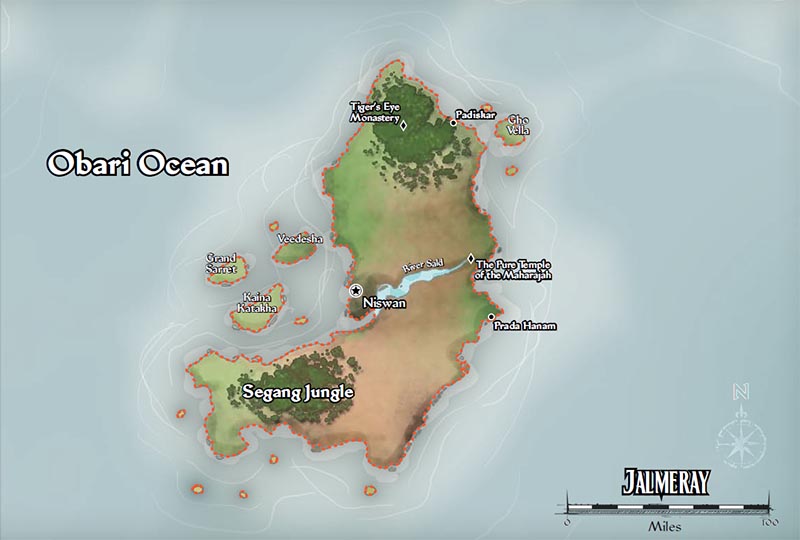
jalmerayWhen her parents announced that they would travel to Niswan just a few weeks ahead of her 11th birthday, Kali could hardly contain her excitement. It had been over five years since she had last seen her grandparents or the city where her father was born, and she could recall very little of her time in Jalmarey with any clarity. Some of that was simply the nature of a young child’s memory, but in the years since then the Nassim family had also been to the foreign ports of Kalsgard, Azir and Merab, numerous smaller settlements in Cheliax, and even briefly—very briefly—to the docks of Promise in Hermea (speculating about why Mengakare wanted those items would be a family pastime for many years). After the move to Sandpoint and the settling in at her new and now permanent home, those memories of what she saw as a young girl of six in Niswan were competing with others more recent and far more vivid.

She read a great deal about her father’s homeland in preparation for the journey and the more she read the more obsessed she seemed to become. At first, Akmal was concerned that the Kingdom would not live up to her expectations, but Denea quickly pointed out how unlikely that was: Niswan was a city that was formed, and still shaped by, the elementals and genies weaving magic in service to the Vudrani rajahs. Jalmeray was the west-most Impossible Kingdom and in this case it’s name was no exaggeration: the Kingdom itself would not and could not exist if not for the outsiders that were instrumental in its creation. One evening, Kali had asked if it was true that there were palaces “where the fountains flowed with wine instead of water”. Her father replied, nodding, “I have seen it”. How was it possible to be disappointed with such a place, when the reality was so much more fantastic than any story could convey?

And Denea was proved right in the end, as she often was when it came to her daughter. The almost eleven-year-old Kali was in awe of Niswan’s wonders. She walked on streets of red stone, between ornate pagodas several tiers high, silken streamers on their roof tops flowing in the wind. And the marble was everywhere: buildings, statues, fountains…some of them a pure white that gleamed int he sunlight. Niswan was a delight for the eyes, and there were many delights for the other senses as well. Now that she was old enough to appreciate it all she found the city to be nothing short of majestic.

Young as she was, though, she was also very keen and it did not take more than a few days for her to suspect that, aside from the culture, something about Niswan was very different from the other cities she had seen. It nagged at her. There were some obvious contrasts. The streets of Niswan were not just clean, but immaculate. The city itself was busy and bustling, yet also quiet and distinguished. It even seemed to have an effect on her mother: normally outspoken and rarely hesitant to offer her opinion on matters, Denea was reserved and deferential here (some might even call her behavior “polite”, though perhaps not within earshot). Yes, those things were obvious, but there was something else. Something much more subtle.

It was a couple of days before it came to her. Every city had its social and economic divides and Kali was under no illusions as to where she and her family fell on these scales. While the developed world might consider Sandpoint to be little more than a backwater settlement, her family’s life there belied its means. Children her age, or of any age for that matter, did not as a general rule travel the world, much less with her frequency. Most people did not leave their own country except to flee for their lives or as (unwilling) property of another. She knew, even at this age, the privilege under which she lived and a large part of that understanding came, surprisingly, from her mother. Denea not only didn’t shelter Kali from the harsh realities of poverty, at times she deliberately exposed her daughter to it. “Your father’s influence,” she would tell Kali many years later. “I wanted to raise you better than I was.”

What Kali saw in Niswan was a city like any other, except…there were no impoverished. There were poor, for sure, but she had yet to see what had been a common sight in every city of any size: the desperately poor, with no money and no prospects, surviving only at the generosity of others. There were no beggars, no homeless, no squatters and no squalor. When she broached the subject with her mother that evening, just as she was going to bed, Denea kissed her forehead and said, “You are an observant and clever young lady. And it is too late to talk about this tonight.”

Her father woke her very early the next morning, before dawn. “There is something I need to show you,” he said.

Two white horses were tied at the post in front of her grandparents’ home with reigns and saddles for riding, and Akmal helped her up onto the smaller one before untying them and mounting his. Once he was satisfied that Kali was ready, he said only, “Follow me,” and trotted off.

Akmal led her through the city as day broke. Whatever questions she had he was not ready to answer, and she eventually gave up on asking them and rode behind her father in silence. After nearly three quarters of an hour they had left the city proper, traveling along a small road on a grassy hillside overlooking the water. Down below, a rough path emerged from the brush and trees just above the shore, which it followed to austere wooden docks.

Akmal stopped, dismounted, and motioned for Kali to do the same. She eyed two  baqaara, ornately decorated as she had come to expect from Niswan (and in stark contrast to the docks where they were moored), sitting in the perfectly still water. Two men—a boat captain and a dockhand, Kali presumed—were preparing one of them for launch.

“Now, we sit and wait.”

In time, four hooded, cloaked figures emerged from the trees below, following the path to the docks. They approached the readied boat, greeted its captain, shed their cloaks and stepped aboard.

Kali gasped audibly.

“What happened to them?”

“This Kingdom was born from elemental magic 4,000 years ago, shaped by the will of the Maharajah Khiben-Sald. The magic of the genies still serves the rajahs today, alongside that of powerful sorcerors. This magic is responsible for the wonders around us, including the unnatural order you have seen in Niswan where even the lowest caste is provided for. But all these things…they come at a cost.”

The four figures took their seats, two choosing oar positions along with the captain.

Akmal continued, “All of this magic from hundreds of spells flows around us like the wind, and like the wind it is harmless…except on rare occasions when it is not, and causes these afflictions. This is the toll levied on a city created by, sustained by, and bathed in powerful magic from both our world and beyond.”

Kali watched in silence as the dockhand untied the baqaara’s mooring lines.

“If you are wealthy, or well connected, or simply have a large family of even modest means, you can pay to be cured. If you have none of these things…” He paused before continuing. “A lucky few are not severely stricken and may even recover in time. Most, however, are like this. They eventually become burdens on their families. When they have nowhere left to turn, they turn to the island of Gho Vella.”

The baqaara shoved off and its captain steered it away from the shore as the oars were lowered into the water.

“These men who ferry them. They do not ask for payment. No one knows why they choose to do this; if you ask them they will not say. We call them ‘The Curse Shepherds’.”

The boat picked up speed now, the captain and oarsmen rowing unsteadily at first but eventually smoothly and in concert. It was several minutes before Kali spoke.

“Why Gho Vella? What’s there?”

“I don’t know. Very few people do; I imagine that even fewer care.”

§