
Tag Archives: Aemi

Aemi’s Journal, Erastus 22, 4719

Elidir

evening

I’ve spent two nights staring at a blank page. Two nights of opening this journal, then closing it again with nothing written. 

I leave for Breachill tomorrow and will arrive there in three days. I’ve left places before, built new lives for myself before. This is nothing new. So why is it so hard to write about it? Why is it so difficult to face it?

Maybe it’s because every place I’ve lived has been an escape from where I was. The Conservatory was my escape from home. From mom and dad’s constant fighting. From the reality of our financial collapse. From a family that had been coming apart long before I was brought into it.

Macridi was my escape from Kerse. From the shame and embarrassment of living through it. I had no one, and couldn’t bear being myself. And for a while, it worked. Only, Macridi wasn’t fully real. I moved through people there without staying. No one knew me because I didn’t let them. The comfort it provided was real, but it just wasn’t enough.

The Minstrels were the first time I felt authentic. I joined them, and that was a choice. So I was reaching, not running. I wanted real connections again. But maybe that need for belonging was still an escape from who I’d been. Who I’d chosen to become.

I’ve seen this pattern before. I saw it in the forest. It’s why Iskaryn is here with me, now. But seeing it doesn’t make it easier to escape it.

And now, I am about to do it again. Create a new life, a new me, in a new place. A more authentic me, if Iskaryn has anything to say about it (and she has plenty to say). But it has never worked before. Never for long.

Nish was convinced I am moving towards something, not running. I don’t know if that is true, but I want to believe it. I guess it comes down to whether, this time, I will build something I can remain inside.

I don’t know who they are. Only that I am meant to recognize them. And be recognized in return.

Aemi’s Journal, Erastus 19, 4719

Conerica Straits

evening

We’re outside a small settlement, but I decided to stay with the camp rather than head into town. I’ve been avoiding the places we visited when I was last here because…I don’t know why. I guess I just don’t want to deal with it.

I was playing my flute casually, just some light and airy pieces that put some music out there without demanding attention. Something people could either listen or just talk over depending on their mood. I’d been doing this for half an hour with a small crowd around me when that group of three surprised me by taking seats at the fire. They had gone into town earlier–the sudden quiet was almost startling–but now they were back.

“How about something we can dance to?” one of the two men asked.

And just like that, I was trapped. I was still raw from two days of trying to keep away from them, but I couldn’t ignore the request without being rude. And I wanted to be rude, surely, but that was on me. They’d not done anything to deserve it. Not really.

Well, fine. I could hide behind my flute (I felt Iskaryn bristle at that thought). I went with an estampie because they have open endings and aren’t too tiring. Just a few sections in, there was clapping and foot-stomping, then someone brought over a wooden crate, and I had a real, if rustic, percussion line. 

The man who requested the change in music was dancing with the woman from their group, and a handful of others had joined in. We had gone from a quiet, relaxing night to a small but lively party in just a few minutes.

I switched us to a carole, and almost immediately a circle formed, everyone interlocking arms. This was more relaxed and a bit easier, but ten minutes in, I brought it to a close because I needed a break. There were hoots and applause as I sat down and took a long drink of water.

“Thanks for that. Most fun we’ve had in over a week,” I heard someone say off to my left. I turned to look in time to see one of the men from that group settling next to me. “Traveling through this country is like an extended wake.”

I didn’t know what I was expecting him to say, but it wasn’t that. It caught me off guard.

“I spent three days in Saringallow,” I said, “I’m fairly sure that’s what passes for entertainment there.” 

He chuckled politely in response. “I’m Pates. My friends here are Agelus and Paulana.” They both settled next to him and extended their arms in greeting.

“I’m Aemi.”

This was not what I needed. But. I could feel Iskaryn pushing on me, and I knew why. I needed to get over this…whatever it was. I wasn’t ready to answer questions, though, so I employed the age-old strategy of asking them about themselves first.

“What takes you to Elidir, Pates?”

“They’re renewing a push for a passage north and put out a call. We’re answering.”

Demand for Isgeri exports has always been high in Molthune, and the safest routes between the two all pass through Druma, which ruthlessly exploits this advantage. Lately, Druma has been raising tariffs on goods coming from Isger, and Cheliax started paying attention. With their influence waning elsewhere, they’re making another push to invest in Isger. Opening a passage north and kicking Druma from the table would be something of a two-fer.

This is basic Druma. They teach us this stuff practically before we learn to read. And, for the next half hour, it gave us something to talk about that wasn’t me.

Then the grace period expired. “So how about you? What has you going to Elidir?” Pates asked.

“It’s just a stopover,” I said. “I’m headed to Breachill.”

“And what’s waiting for you in Breachill?” Paulana asked.

I went with a version of the truth. “A better life than I can make for myself in Saringallow, for sure. Breachill was…recommended to me by someone I trust. I don’t know what I’ll find there, exactly, but it can’t be worse than where I was.”

“And where was that?”

“Rock bottom and digging.”

They could tell I didn’t want to go into it, which I appreciated. We made some small talk for a bit, then I politely excused myself to turn in for the night.

Honestly, they are decent enough people. This anger, or resentment, or whatever it is I am feeling towards them is obviously not earned, and it’s certainly not fair. But it’s not so easy to just turn off, either. Still, I can’t go the rest of my life avoiding people for the crime of being friends, so I’m going to make the effort to spend time with them tomorrow.

I don’t have to enjoy it. I just have to try.

Aemi’s Journal, Erastus 18, 4719

Conerica Straits

afternoon

It’s been ten months since I last traveled this stretch of road to Elidir. With every mile I walk, there’s a tightening in my chest and a growing sense of unease that I can’t seem to shake.

The last time I was here, I was not alone.

There’s a group of three travelers with us, two human men and a woman, who have clearly been companions for a long time. They move together, speak across one another, and laugh too loudly at things that cannot possibly be that funny. It grated on me all morning.

I tried to put some distance between us, but their voices carried in a way that others’ didn’t. I moved ahead, fell back, and even kept to the far side of the wagons to block the sound. It made no difference. Even now, as we’ve stopped for a short lunch, I can hear them. Do they not even stop talking to eat?

I get fragments of their conversation whether I want them or not (and I do not). They are adventurers or expeditioners of some sort, apparently seeking a passage north through the Menador Mountains to Molthune.

And now that I’ve written that down, I think I understand why they have been getting under my skin. I keep seeing the Minstrels in them, and I resent it. I resent that they still have each other.

Iskaryn hasn’t been much help. Sometimes she’s a mirror; others, she’s a window. Right now, she’s neither, which makes this one of those rare moments when she doesn’t have an opinion to share–or impose on me.

Which is, I suppose, an opinion of its own. One that suggests that I just need to deal with this, and her involvement would only complicate it

Aemi’s Journal, Erastus 17, 4719

Conerica Straits

afternoon

The caravan to Elidir assembled along Saringallow’s riverfront, which is close to the warehouse district. This presented problems for repeating my “offer Iskaryn as a scout” strategy, as that required calling her back to me; essentially doing the exact opposite of what I had been warned about. I was fretting about this all morning.

As it turned out, I needn’t have worried. There’s a large temple to Erastil here, and thus no shortage of wardens, scouts, trackers, and guides, many with animal companions. This caravan had two already, and Iskaryn’s services would not be needed.

The money I earned with Nish is going up in smoke. Three nights of nothing but expenses, followed by this.

But I wasn’t done. After all, if I am going to bleed coins, I might as well do it properly.

I realized I’d been taking my own safety for granted, especially given the stories about Isger—those walls in Saringallow exist for a reason. Yes, the Conerica River and its northern branch are patrolled, but they can’t be everywhere at once. All the merchants in this caravan (and the last one) wore some form of protection, and most of the travelers did as well.

And there was the same problem I had on the first day out of Petitioner’s Port: the look that says “she needs protecting” and the offers that follow.

Fuck that.

Nish put a stop to it last time just through proximity, but I needed to solve it for good on my own. So I purchased some simple leather armor.

Iskaryn was pissed off about it. One, I bought it without her there because we were in Saringallow, and two, because it cost me much of what I have left. Which suggests she would have tried to bully me out of it.

We must have been overdue for a row because we had a proper one when the caravan stopped for lunch. Thankfully, we both had the presence of mind to do it away from the group, so all I got was a bunch of concerned looks instead of hostile glares.

“You’ll need that money when we get to Breachill,” she said.

I countered, “It’ll do me no good if I’m dead.”

“You have me to watch for trouble and warn you!”

“You can’t deflect arrows and blades!”

“You don’t know how long it will take to find them! What if you run out?”

“Says the bird who forced me to buy that fucking journal!

We attracted the attention of one of the hawks, a companion to one of our trackers, and it landed on the ground and glared at us. And, yes, I know what it looks like when a bird glares, because I have experience.

Regardless, I wasn’t in the mood for a nanny–already got one in the form of her nibs–or a social critic. “We’re fine!” I yelled at it. “She’s just being an ass!

It looked at me, then at Iskaryn, who screeched at it indignantly. Then it flew off. I have no idea if it understood me or not, but the message was apparently received.

We’ve both cooled a bit, though I can feel the occasional flare of disapproval from her direction. If she had hands, she’d be wringing them. Or throwing them up. Possibly both.

She isn’t wrong about the money.

I’m not wrong about the armor.

And that’s the problem.

Aemi’s Journal, Erastus 15, 4719

Saringallow

Evening

Nish left today. She’s going by boat because the roads west of here aren’t the safest way to travel, so we said our goodbyes on the docks at the riverfront.

“I’m not very good at this,” she said to me. “Saying good-bye, I mean. You’d think I would be by now.”

“Me neither,” I said. “I never know what to say. And I’m best at just avoiding it altogether.”

We embraced for a long time, then pulled away, both our eyes wet with tears.

“Look. I don’t know what happened behind you. But I know the difference between moving toward something and running away. Keep moving toward it, all right?”

I could only nod, fast and tight, then gave her another hug.

She pulled away first and boarded without another word.

Through the bond, I felt Iskaryn’s steady presence from somewhere above the rooftops. Not pushing. Not correcting. Just there.

I stayed and watched until the boat pushed off and slipped into the river’s current.

Aemi’s Journal, Erastus 14, 4719

Saringallow

evening

Thilo was right about this city. Everywhere I go, it’s cold shoulders and narrowed eyes. Service delivered like an obligation, not a welcome. When I paid for my room, the innkeeper looked at me like I had no right to be here. What’s the point of running an inn if you resent the people who keep it standing?

Any fantasies I had about finding an inn or tavern to perform have been quietly strangled. No one wants an outsider. I don’t get it. I look around, and trade is everywhere–there are boats along the river, markets and shops with goods from beyond Isger, and of course our own caravan which brought cargo in addition to travelers. I must have missed the sign that says, “We want your money. We just don’t want you.”

But, Nine Hells, it’s more than even that. These people barely seem to want each other. I overheard two elderly men in the common room, and one of them actually said, “True friends aren’t too friendly”. Apparently, that’s an aphorism around here. They’re suspicious of their own neighbors.

There’s more cheer at the town gallows. Magdh, there are two of them.

And I get to spend three more nights here before the next travelers leave for Elidir.

Iskaryn is faring better than I am. The walls around us are high, but they enclose stretches of the farmland that surround the city–and its spite. There’s also a shabby orchard in the city’s center, the trees overgrown and gnarled from neglect.

From what I feel through the bond, she prefers the orchard and perches there during the day. As long as she minds Thilo’s warning, she can pass for nothing more than a particularly self-possessed bird.

She can feel me, too. When a stare lingers too long, or someone’s tone sharpens, I can feel her tense up. There’s this restrained indignation at the edge of my thoughts. She wants to intervene. I know how badly she does.

But she’s keeping herself in check.

Aemi’s Journal, Erastus 14, 4719

Conerica River

morning

Thilo came to talk to me just now, before the caravan started moving this morning.

“There’s a couple things you should know about Saringallow,” he said in Sylvan. “It concerns the bird.”

The original name of the town, he explained, was Sarini’s Hollow, named after House Sarini of Cheliax, which established a small estate there. The town grew around the estate, as towns do when there’s a steady supply of work and money. Then the Sarini’s started dabbling in witchcraft, and because Cheliax is Cheliax, they turned their craft inward. Then they preyed on their own town to feed it.

When the townsfolk caught on, there was a huge uprising, and all the Sarinis were hanged. “Sarini’s Hollow” became “Sarini Gallows”, and in time it was shortened to the cheery name we know and love today.

“And what’s this got to do with me? Or Iskaryn?” I asked. I mean, it was everything I hated about Isger all in one tidy, horrible package, but so what? Lots of places had dark histories.

“It’s an insular place. They aren’t real warm to travelers, see. You’ll be welcome as long as you are spending your money, but not a moment longer. And, because of their history, unless you’re a priest of a respectable faith, open displays of magic don’t sit well with them.” He hesitated. “And that’s, uh, where the bird comes in.” His tone went dour there. He didn’t say, especially with her attitude, but he didn’t have to. The message was received. Iskaryn literally ruffled her feathers at that, but said nothing.

So that’s just great.

Iskaryn has been a lot of things. She has been my conscience, my shield, and my anchor. She’s stopped me from falling into old habits. She’s pushed, if sometimes dragged me forward, when I just couldn’t summon the will. And Magdh knows she’s been stubborn, irreverent, and infuriating.

But she has never been a liability.

He must have seen something in my face, as he softened his normally gruff manner. “You don’t have to do anything drastic. Just keep it subtle.” He gave Iskaryn a pointed look. “And act like a bird.”

To me, he said, “I’m telling you this because she’s done well by us. By me. She’s spotted trouble a couple of times, and because she can talk, we dealt with it before getting close. So I’m returning the favor.”

“Thanks, Thilo. I appreciate the warning. We’ll figure it out, I guess.”

I hope that is true.

Aemi’s Journal, Erastus 11, 4719

Conerica River

night

Nish and I have been performing together these past four days. Mostly it’s been for the other travelers in the evenings, but we’ve also played a couple of taverns when the caravan stopped in towns along the way to take on more lading. I am a little stunned by how much money we’ve pulled in doing this, though I am pretty sure that most of that is on her. Still, I am not going to complain. She is letting me keep half of the takings, which is ridiculously generous and most appreciated.

I thought about asking her why she’s being so kind to me, but I’m pretty sure I know the answer. Iskaryn is confident that we won’t be living off handouts for much longer, but right now? I just don’t see an end to it.

Thilo has finally warmed up to me. Much of that is due to Iskaryn, who seems to have successfully smoothed things over with him (which is only fitting, since that was a mess she made). She takes her scouting role seriously and has even offered to get her direction straight from him instead of going through me. But I also can’t completely ignore that I’ve been spending quite a bit of time with Nish, and Nish is, as I said, quite stunning. I mean, I am not inclined in that direction myself, but Maghd, I am not blind; I can’t help but look. Thilo sure isn’t blind to her, either.

I had the idea to start learning more about where we’re headed, so I started inquiring about Breachill in the towns we’ve been passing through (I considered asking my fellow travelers, too, but Iskaryn seemed to think that was a bad idea, as it would invite questions that I am not comfortable answering and unable to escape).

I spoke to just over a half-dozen people, and just about every response started with: “It’s weird.”

If you don’t think that “it’s weird” provides sufficient detail about my destination, then you would be correct. So I pressed for details, and this is the picture that emerged: Sometime around 200 years ago, a bunch of pioneers settled in northeast Isger, in the foothills of the Five Kings Mountains, where they border Druma. Shortly afterwards, some insert-unexplained-phenomenon-here occurred, and they all lost not only their memories, but their ability to survive.

There was a lot of disagreement on what, exactly, is meant by “ability to survive”. Did they lose their resources, their life skills, or both? I never got a consistent answer, but one thing all the stories agreed on was that they surely would have died over the winter if not for the intervention of an altruistic, powerful, and apparently quite unencumbered wizard, whose surname was Breachton. He saved their lives and helped them build their future, hence the name of the town.

That all sounds pretty fantastical to me, especially the part about anyone associated with Isger being described as “altruistic”. But then again, I am traveling the road with a custodial, talking bird, which I summoned deep in a fey forest, sometime between nearly being killed along with the rest of my friends by a fey horror, and being visited by three towering figures of fate in the service of Magdh, who handed me a Harrow card with my own image on it. So who am I to judge what’s real?

One other point all the stories agree on is that Breachill, as a community, is fairly open and welcoming, in the way most settlements in Isger want to be, but can’t quite achieve because of the influence of old Cheliax or the scars from the goblin wars. It formed and grew somewhat disconnected from the country around it, and that has stuck. I can’t help but be reminded of Macridi, and while there is certainly some amount of wishful thinking on my part there, it does make me feel more at ease about where I am headed.

I pulled my Harrow card out after I was sure Nish was asleep, or at least pretending to be. I’ve seen these cards for sale here and there, almost always from fortune-tellers that are heavy on spectacle and light on substance. I haven’t been brave enough (or foolish enough, if I take Iskaryn’s opinion) to show mine to any of them. But I met a man in town today, a seer who, for whatever reason, felt earnest somehow. I asked him what the card meant.

He said it speaks to loss. Palpable loss, not the abstract kind. The ghostly figure—more pronounced in his deck than in the card I carry—represents those who are gone but never leave us. He was quick to point out that it doesn’t have to mean death: people fall out of our lives in different ways. Regardless, they leave lessons behind, and it is up to us whether we listen.

And, as with most Harrow cards, there is also the predictive meaning: a revelation or discovery from something ancient or distant. But he put less stock in that, saying a reading usually describes who you are, and the predictive is but one possible future. That, and the cards aren’t read in isolation, anyway; the tapestry is considered as a whole.

I don’t know how to square it. I wasn’t given a whole reading, just the single card I’m carrying. So maybe it isn’t about fate. Maybe it’s just a reflection of the decisions that brought me here. Maybe I’ll be faced with a choice in Breachill, and the card is reminding me that we make our decisions through the lens of our experiences.

Or perhaps Breachill is just where the next phase of my life begins, and it’s saying, where I take it is up to me.

When I look at this card, am I seeing my past, my future…or just myself?

Aemi’s Journal, Erastus 7, 4719

Conerica River

night

We took on some new travelers in Dustspawn, including this stunningly beautiful half-elven woman named Nishlaldara, but who goes by “Nish” because, as she put it, “it was easier for people to pronounce, and less work for me to spell”. I liked her instantly.

She had a cittern strapped across her back, which is what first caught my eye, and we settled down together when the caravan stopped for a lunch break. We wanted to learn each other’s styles and find some common pieces, with the hope of maybe providing some musical entertainment in the evenings. It’s the sort of thing the travelers appreciate, as there’s not much to do along the way besides walk, talk, eat, and, um, relieve oneself.

I’ll get this out of the way: she is far more talented than I am. But, she’s also got about two decades on me, so that came as no surprise.

We made camp together tonight, and were talking instruments when I got sloppy and said, “I always wanted to learn strings, but we could only focus on two families at the Conservatory. In hindsight, vocal and wind were maybe a bad pairing, since you can’t do both at the same time.”

I could feel the next question coming before she asked it. “So you’re performance trained. Where did you study?”

Yeah, I had stepped in it. Even Iskaryn tensed up at that, but there was no way out except forward. “In Kerse.”

“And what’s a formally trained student of a prodigious institution in the Kalistocracy doing walking the roads of Isger?”

The old me, the one Iskaryn was here to keep away, would have spun a story much like the one I had invented for myself in Macridi. But I was trying this thing where I didn’t blatantly lie to people who maybe mattered to me, so instead I went with a vague summary of the truth.

“I’ve made some…bad decisions in my life. I’m trying to make a better one.” For what it’s worth, she seemed to accept that. And she wasn’t even offended when I followed up with, “And what has a talented performer like yourself walking that same road?”

“I was bored with where I was, and needed a change,” was the reply, which was an even more vague non-answer than mine, but probably a fair exchange. We both knew it and left it at that. I mean, we just met, and I wasn’t going to tell her how I’d burned down my life, built a new one, burned that one down, and then set fire to the ashes. We had an unspoken agreement not to push for more, and that was fine.

“Your bird is beautiful, by the way.”

Iskaryn was sitting on my shoulder, occasionally flexing her wings. Her blue was dulled a bit by the orange cast of the firelight, but Nish had seen her properly in the day.

“If you speak Sylvan, you can tell her that yourself. Though she might object to being called ‘my bird’. It’s…a bit more complicated than that. Iskaryn’s not even a bird, exactly.”

“I don’t speak Sylvan,” Nish said, as she pulled out a small clay figure I couldn’t quite see, then cast a spell. “But I can now. For a while, at least.” Which was, admittedly, a neat trick.

“Hold out your arm,” I said in Sylvan, testing Nish’s borrowed language. When she did, Iskaryn flew over to her and settled on it.

I had guessed that Nish was a bard, and I was right. She had me figured out as one, too. While she was admiring Iskaryn up close, she said, “I didn’t even know we could form these bonds.”

“I didn’t either, to be honest. I wish I could explain it. I was…in a bad way, then. So I think it was born out of need more than anything else.”

“And has she helped you…out of that way?”

“I’m not lying my ass off to you now, or running away, either, so yeah. She has. And still is.”

That got a laugh from her, but there was also a hint of sadness beneath it, too.

It wasn’t how I wanted to end the evening, though, or how I wanted her to see me. I liked Nish. What she thought of me mattered. So I said, “Iskaryn and I are learning to play together. Or rather, I play my flute, and she accompanies with a birdsong. It’s still a little rough, but we are figuring it out.”

“Oh, that, I have got to hear! Would you be willing to play for me?”

I smiled and pulled out my flute. I selected something simple, something we had practiced a lot in the days after Alabastrine. Iskaryn surprised me, though, as she tends to do when she is showing off, by improvising a new harmony. Not that I minded. It was far from polished, and we lost the tempo at one point and more than a few notes, but Nish didn’t care. She was thrilled.

Oh my!” she breathed. “That may be one of the most astonishing things I’ve heard. And I have heard a great deal.”

I blushed, but I didn’t retreat into it. “Thank you. We still need some practice, but as I said, we are working it out.”

I’m going to miss her when we part ways. When we reach Saringallow, Nish will head west towards Ravounel, while I’ll go north to Elidir. But that’s okay, I think. Maybe some friendships are temporary, and aren’t meant to last longer than the time we share on the road.

The important thing is that I know I can do this again, and that’s enough.

Aemi’s Journal, Erastus 4, 4719

Dustspawn

night

We’re in Dustspawn for the next couple of days while the caravan takes on lading.

You can’t just walk up to one of these things and tag along like a lost puppy. You pay a fee to be under their protection, which covers the cost of shared guards and scouts, and the safety of numbers in general. There are entire fee schedules—Druma loves its fee schedules—for the things, ranging from how you’re traveling to what you want along the way. Traveling on foot? That’s your base per-person fee. Riding an animal? Takes up more space, spreads out the caravan, and they smell, so there’s a per-animal fee. Pulling a wagon? Harder to defend, and they sometimes break, so there’s a base wagon fee and a per-axle fee. And so on.

You can even get amenities. Don’t want to bring your own food? Your meals can be provided for a fee. Don’t have a tent but want one? There’s a tent rental fee. Don’t feel like walking? There are a limited number of coach spaces. For a fee. You get the idea.

There’s another way to join up, too, and that’s to make yourself an asset instead of a liability. Which meant it was time to put Iskaryn to work.

For all the shit she gives me, when it comes time to rely on her for something serious, she really does pull through. I made a proposal, and she agreed without hesitation (and without an attitude).

“She can serve as an aerial scout,” I offered to the caravan-master. “She can talk, read, and even write, in Sylvan.”

He was skeptical. And I get it. I don’t blame him. Familiars, animal companions, and the like aren’t rare, but ones that can talk are. Literate ones? Even more so.

“Sylvan. How, exactly, does that help me?” he asked,

I speak Sylvan. And this is Druma. Surely, some of the escorts for this thing do, too.” There’s a subtle art to chastising someone without being overtly insulting. I adopted a concerned tone. “Please tell me you don’t travel through the Palakar Forest without someone who speaks the language?”

He relented, though not before asking Iskaryn and me to prove our claim. We sent her off on a couple of simple scouting tests, and he pulled in a dwarven guard named Thilo, who also spoke Sylvan, to act as a translator. He verified everything, and then it was done.

And because Iskaryn is Iskaryn, after the contract was signed, she wrote “Thanks, asshole” in the dirt.

Thilo, to his credit, only paraphrased. But he did chide me quietly, afterwards. When I apologized, he said, “Just keep the bird in line,” and walked away.

So, thanks for that, Iskaryn. Now I get to be extra polite to Thilo for the rest of the journey.

Being a woman (and one who, even in my current state, draws the eye) with a magical bird traveling the road alone tends to attract attention. Most of that attention is either the wrong sort or the sort I am not currently interested in. Case in point. We’re at this inn called The Mineshaft—Dustspawn is an old mining town, so the decor is a whole thing—and I’m writing this all up. A man I did not want to get to know better came up to me just now and asked, “What are you writing in there?”

“I am just keeping a travelogue,” I said, because I try not to be rude to people (even when they deserve it, which, so far, they did not). Also, I need to travel with these folks for the next week, and it’s best not to make any of them mad at me.

“That’s not a language I recognize,” he said, which was deserving, and is precisely why I write this in Sylvan instead of the common tongue. I wanted to say, “That’s so assholes can’t read it over my shoulder,” but, again, trying not to be rude. So I went with, “Oh.”

The best way to end a conversation you don’t want to have is to smother it in the cradle. It’s hard to respond to “Oh” because there’s nothing to work with. After a few awkward moments of him just looking at me, waiting for me to go on, he gave up and left.

A triumph for the power of “Oh.”

Aemi’s Journal, Erastus 1, 4719

Petitioner’s Port

evening

I walked alone to Petitioner’s Port. 

Iskaryn objects to my use of the word “alone”, since she was, of course, with me the whole time, but she knows full well what I mean by “I walked alone” and if you want me to do this, Iskaryn, please stop being so pedantic.

I could have waited for other travelers and followed along, or maybe even joined a small traveling group, or waited for a caravan, but honestly? I didn’t want the company, and I really didn’t want to spend another night in Albastrine waiting for company, since that also meant spending more money, and more money is something we just do not have.

See? I said “we” there, Iskaryn. Are you happy now?

Petitioner’s Port is quieter than you’d expect for what was meant to be Druma’s grand southern gateway. The Kalistocracy imagined lines of hopeful petitioners streaming north—hence the name—but the place feels far more practical. Even the road from Isger is called The Path of Commencement, which tells you everything about how the Kalistocracy sees the world. It isn’t the road to Isger: it’s the road from it. As if the only direction that matters is inward.

The town itself never bought into that way of thinking. It grew on its own terms, around work and trade and whatever made sense at the time. It reminds me of Macridi in that way. Half the buildings are redwood, likely cut from the same forests I once walked through. If I’m going to leave Druma, at least I’m doing it from somewhere that feels real.

It occurred to me, because I can see the obvious, that I could just buy passage on a boat from here and be back in Macridi in a couple of days. We could even travel all the way back to Kerse. I said this out loud to Iskaryn, and she screeched so loudly that she stopped traffic on the street. I am not kidding: everyone turned to look at us. Well, the joke was on her, because I just wanted to see what kind of reaction I would get, and she did not disappoint.

Childish of me? Yes. But I’m not pretending that I didn’t enjoy it, and that’s why you shouldn’t read over my shoulder while I am writing in my diary, Iskaryn.

There is no way in the Nine Hells I am walking alone through Isger, so this time, I am waiting for a foot caravan. One is organizing now, and will leave for Saringallow in a couple of days. For once, Iskaryn and I are in agreement: this is not the time to spend my days alone, especially alone and brooding to myself, because it’s just not safe. And while I can’t just get over it, I can learn to live with it, and that is really the first step. So, forced company, it is.

The caravan will stop in Dustspawn, which is a day out of the way in addition to a short layover, and Iskaryn isn’t happy about that (how she knows so much geography is anyone’s guess). I pointed out that we didn’t have much of a choice, and she, grudgingly, agreed. The only reason I am writing down this otherwise unimportant detail is to record that I won that one, even if she only grudgingly admitted it.

There are a couple of decent taverns here, but for whatever reason, I’m not finding my footing in them. The travellers here are more focused on where they are going, or why they are going there, or whatever, and music isn’t really on their minds. I am used to having to perform above the din of a dining hall, but nothing like this. I hope the rest of the trip doesn’t go this way, because we absolutely cannot afford to spend more than we are bringing in.

Iskaryn and I are in agreement on that point, as well.

Aemi’s Journal, Sarenith 28, 4719

Alabastrine

late night

I needn’t have worried. This is the first inn I’ve stayed at in months, and when I looked in a proper mirror, I was shocked by my reflection. I’m so gaunt that I barely recognize myself, and I doubt someone who saw me for a couple of days eight months ago would do so, either. While Davio taught me a handful of spells that were useful for a life spent mostly on the road–including one that kept me clean enough to neither look nor smell like the vagrant I’ve become–none of them provided food. This is what weeks of near-starvation look like.

The point was driven home when I sat down for a late lunch in the common room. The server put a large bowl of stew in front of me and said, “This one is on the house.” I didn’t ask. I knew why.

“I can perform tonight, if you like,” I said to her. The inn was nothing special, but I couldn’t afford better. Truthfully, I couldn’t afford “nothing special”, either, but I had to stay somewhere, and the cheap ones aren’t great for live music. Some aren’t even safe to sleep in. If they’d have me, I could make this one work.

She gave me a skeptical look–I would have done the same in her position–and she told me I’d need to speak to their manager first. Fair enough. It was just another audition, and I’ve had plenty of those.

I’d set aside some of the money for a flute, and finding a simple wooden one in the city markets was easy enough. It was a far cry from what I had been playing the past couple of years, but it would do. A couple of hours later, I was performing for the evening crowd.

As absurd as it sounds, playing taverns and inns along the way is my plan for reaching Breachill without starving. The math barely works. Most nights I’d just break even, but if a few go as well as tonight, I’ll come out ahead. If not… well, I am trying not to think about “if not”.

I’m also trying not to think about Isger. We didn’t spend more than a few weeks there, but that was long enough to make me dread going back. To put it bluntly, I don’t feel safe there.

Traveling the roads in Druma carries little risk. For all that people complain about the Mercenary League being cozy with the Kalistocracy, they do a good job of keeping the trade routes free of trouble. I have walked countless miles both in small groups or completely alone, and I rarely felt threatened. Isger is another matter entirely. I’ll have Iskaryn to watch out for me, sure, but I am better off not traveling by myself.

But that’s a problem for another day.

Aemi’s Journal, Sarenith 23, 4719

Western Druma

evening

I don’t even know what I’m supposed to put in this thing, so I asked Iskaryn, since this was her idea, and she answered, “The truth,” whatever that is supposed to mean. As that was not a helpful response, I followed it up with, “The truth about what?” and she gave me this funny look–and yes, I know she’s a bird, don’t ask me how I know it’s a funny look, I just know–and she said, “About how you feel. About your experiences.”

Except she knows I don’t want to talk about any of those things–I just want to forget most of it–so I said as much, and she just pointed out that this is how I got here. I didn’t have a response to that. Then it hit me: I was being lectured about the healing power of journaling by a magical bird that can’t even read or write.

And I must have said that out loud because she retorted, “I can do both,” and I just stared at her blankly, because what do you say to that? Which she took as a challenge, and proceeded to demonstrate it to me, promptly scratching out the Sylvan equivalent of “See? I told you so” in the dirt. Which is when I realized there was no escaping this trap she has set for me. And, yes, Iskaryn, I know you are reading over my shoulder as I’m writing this, and please stop it.

She objects to me characterizing it as a trap, and insists that this journal, or diary, or whatever I want to call it, was merely a suggestion.

Here’s what she means by “suggestion”: We’re at this trading post where the river–yes, that river–joins the Profit’s Flow, and I’m trying to buy food and water so I don’t starve over the next few days, and because I need a change from living hand to mouth in the wild. She lands on this book with an oil-skinned cover and starts shrieking at me. I try to shoo her away, and she comes back to it and does it again. This repeats a couple more times, and the shopkeeper, who apparently sees birds do this every day because he doesn’t even flinch, says, “I think they want you to buy that.”

Which, of course they would say that, because it’s expensive and they’d love nothing more than for me to give them money. And I’m looking at how many coins I have and realizing, sure, I could get this and a reed pen, or I could maybe eat for three weeks instead, and I try to explain this to Iskaryn–let’s not even go into what that must have looked like, me standing there, arguing with a bird who’s just shrieking back at me because, I don’t know, actually talking would draw too much attention somehow–and she is not having any of it.

I must look like I’m on the verge of a complete breakdown or something, because the shopkeeper takes pity on me–or maybe he just wants us to leave–and offers me a discounted price on it. And all I really want is for Iskaryn to just stop, so I agree to it, and now I’m going to run out of everything by the time I hit Petitioner’s Port. But at least I’ll be able to document it when it happens.

So, yeah. “Suggestion”.

I am supposed to record “the truth”? Okay, fine. Here’s some truth.

It hurts. It’s been almost four weeks and it hurts. Some days it feels like it just happened. Others, it feels like a lifetime ago. But that ache is always there. They’re gone, and there’s this enormous hole inside of me, and I don’t even know how to begin to fill it. And. It. Hurts.

It took me four days just to get out of the forest–four long days of one step ahead of the other, with Iskaryn flitting between branches above me. Then another day, along the road to here, slipping back into the trees whenever Iskaryn spotted someone approaching, because…I don’t know why. I just wasn’t ready to be seen yet. Or maybe I wasn’t prepared to see others. The walking helped, though. It kept me from replaying events. From wallowing in sorrow. It gave me something to do.

It would be so easy to just…give up. Go to Macridi–it’s not even half a day’s walk from here–and step back into that life. I could do it. It’s so tempting to do it. Only, I’m not that person anymore. She never even existed. She was just someone I made up, a role I could play based on half-truths because it didn’t require any difficult choices. So even though I could go back there, I just can’t. Someday, maybe, but not now.

This trading post has a shelter with small rooms that they let out to travelers. The norns didn’t deign to supply me with a schedule, but the way I figure it, they can see the strings of fate, right? So they’ve already seen all this, which means my time spent here is baked in. I’m just going to assume that however long it takes me to get to Breachill is how much time I have, and not fret over a couple of nights in a real bed for the first time in months. It is far from luxury–far from even a rundown inn–but it’s a bed nonetheless, and I’ll take it.

I’ll worry about the rest of it–how I’m going to get there and, more crucially, whether I’ll be recognized in Alabastrine–in the morning.

Aemi Salinas (Sura), Human Female Bard (Duettist)

Part 1

Aemi grew up in the minor noble House Sura in Kerse, the capital city of Druma. Her paternal grandmother, Euphema, had a reputation for wisdom and careful judgment, and was widely respected among the city’s merchants and minor nobility. Her grandfather, Mercus, had built the family’s standing from modest beginnings through successful trade and careful investments. When they died unexpectedly, their only son and Aemi’s father, Quaris, inherited their estate.

Quaris moved his family into the manor when Aemi was eight years old. His parents had left behind a respectable inheritance: the house itself, a modest reserve of gold and liquid assets, and several steady sources of income tied to property and investments. For Aemi, Euphema had also established a trust intended to ensure that she would receive a proper education in the cosmopolitan city, with her parents named as its trustees.

But while Quaris inherited the estate, he did not inherit the instincts that had built it. Over the following years the family’s finances began to unravel. At first the problem was simple enough: they spent more than they brought in. But Quaris tried to solve it by chasing new income rather than tightening their spending. He poured money into increasingly risky ventures, and those that were not ill-conceived to begin with faltered under his poor management.

As Aemi grew older, the signs of strain became impossible to miss. The staff was slowly shrinking in size, items were wearing out or breaking without being repaired, the grounds were deteriorating as caretakers were dismissed, and so on. By the time she was fifteen, the manor had developed a shabby appearance, and she could see more clearly the differences between her own standard of living and those of her friends—especially when she visited their homes.

And then there were the fights. At first they had been muffled arguments behind closed doors, but over time even that pretense disappeared, and they grew louder, and more frequent.

During one particularly bitter argument, Quaris accused Verana of stealing from him. The accusation struck Aemi as absurd. Their troubles were plainly the result of his own mismanagement, not some conspiracy involving his wife, and besides, their assets were shared by law. The idea that Verana could somehow steal from him felt less like a claim and more like desperation.

Aemi’s only escape from the chaos at home was the Kerse Conservatory of Music, where she enrolled at the age of eighteen. For a time it offered distance from the tensions of the manor; distance enough that she could almost pretend they didn’t exist.

It didn’t last.

In her second year, her mother appeared at Aemi’s student suite and said to her, “I’m leaving your father. I hope you understand.”

The only thing Aemi didn’t understand was why it had taken so long, but when she asked, “Will you be all right, financially?” she learned a shocking truth.

Her mother had seen the decline of the household years earlier, long before Aemi reached her teens. Unwilling to watch her life collapse alongside it, Verana had spent that time quietly skimming money from the family accounts and placing it into a private reserve for the day she would leave.

The revelation left Aemi stunned. Years of quiet deception sat uneasily beside the image she had always held of her mother. Verana, however, spoke of it as though it were the most practical decision in the world. When she asked Aemi to withdraw from the Conservatory and leave Kerse with her, the request felt less like an invitation and more like the final step in a plan that was years in the making.

Still reeling, Aemi refused.

This response touched off a bitter argument, and what began as disbelief quickly hardened into vitriol on both sides.

Fine,” Verana snapped at last, the word dripping with contempt. “Then you can stay here with your father.” 

She turned and left in a fury.

Aemi didn’t know it then, but that would be the last time she saw her mother.

When the term at the Conservatory ended, Aemi was informed that she would not be allowed to return because her tuition for the coming year had not been paid. Assuming some mistake had been made with the payments from her trust, she arranged a meeting with the trust’s protector. As the explanation unfolded, she could feel her life steadily unraveling. Years earlier, Euphema (believing she was making the responsible choice) had named Verana as sole trustee in the event the marriage dissolved.

Her own mother had modified the trust and assigned a new beneficiary.

Unwilling to live with her father as he spiraled into financial ruin, and even less willing to seek out her mother (assuming she could find her), Aemi was, for the first time in her life, completely on her own. With only her meager accounts and half-completed music education to support her.

Part 2

Aemi had three days to figure out what she would do next, as that was when the term ended and she’d be expected to move out of her suite. Three days to come up with a plan that would get her through the start of the rest of her life.

The first step was figuring out how long her money would last. She had only a vague understanding of what things cost, but she was resourceful and rather good with people, and motivated to learn. She visited flats, tenement buildings, flophouses, and communal lodges; markets, bazaars, dispensaries, tailors, general stores, and farm stalls. Two days later, sore and exhausted beyond all measure, she stumbled back into her room with a better understanding of where she stood.

Aemi considered the three lowest buckets of living conditions: “can make it work”, “only if necessary”, and “total desperation”. Without any source of income, her money would support her for six to seven months in Kerse, and up to twice that long, depending on how far she was willing to travel, and how much she was willing to compromise on her standards.

Living in Kerse was not an option for more than just financial reasons. She couldn’t go home–she couldn’t put herself through the shame and embarrassment of her family’s collapse–and staying in the city would just stretch out the humiliation. Eventually, someone, somewhere, would recognize her, and then the questions would come. And, besides, the city’s gossip rags found the Sura family’s fall from its noble heights a perpetual source of entertainment. It was hard enough to live through it (You mean “run away from it”, that voice in her head corrected; she ignored it), she didn’t want to be reading about it, too, especially when you never knew when the next column would print. So, travel it was.

On the third day, Aemi packed up her essentials, sold the ornate, ivory flute her parents had given her (and purchased a modest wooden flute to replace it–she wasn’t an animal), and walked out of her suite, leaving the rest of her belongings. She spoke to no one and left no message behind. She didn’t even shut the door. When the staff at the Conservatory checked on her that evening, it was as if she had simply disappeared.

Part 3

Five months and over 140 miles later, Aemi, now using the surname Salinus, arrived at the logging town of Macridi. Her coin had depleted faster than she had expected, and at the current pace she had, maybe, another three months before she would be forced to let go of “only if necessary” and fall back to “total desperation”.

Work had been difficult to come by. The cities and towns became progressively smaller as Aemi traveled the Profit’s Flow away from Kerse, and most had nothing for her, especially since she had little to offer in the way of skilled labor. She gave each stop a few days, sometimes weeks, looking for something more substantial than part-time menial labor, before giving up and moving on. The one job she managed to find that was well-suited to her was at the Torch Orchard as a sort of receptionist for visitors–mostly merchants and tourists–but it was just a temporary thing, lasting only a couple of months until the season changed. Even if it could have been something permanent, the “only if necessary” expenses in such an exclusive region were barely covered by her income, so she couldn’t stay there forever, anyway.

Aemi’s frustration, and sense of desperation, was steadily growing. She nursed a lot of anger at her parents during this time: at her dad for bringing financial ruin on them all, and at her mom both for the depths of her deception and for cutting off the trust out of spite. That Aemi’s own financial situation, at least the part where she was spending more than she was earning, now mirrored her father’s was just more fuel for that fire. And while the anger did wonders for her resolve, in the back of her mind there was this tinge of guilt for what she had done, and how she had done it. Acknowledging that guilt, though, was an unpleasant thought, and it threatened to release a floodgate of mixed emotions that were worse, so she buried it deep and focused on the future. Besides, she thought, it was too late to change anything now.

Macridi was the first significant settlement after the three-day journey through the heart of the Palakar Forest. The forest itself was home to three faerie courts, each with differing opinions on trespassing by outsiders, so settlements along the river were rarely more than small and transient logging camps. In contrast, Macridi had come to an accord with its neighbors, and by exercising restraint over its logging activities, the town was able to grow both its industry and its population. It was home to over 3,000 permanent residents and responsible for the choicest darkwood and paueliel in all of Druma. That restraint in the logging industry also carried over to other aspects of life in town: unlike those in most of the polity, Macridi’s residents did not find it necessary to flaunt their wealth. To Aemi, it felt like a real city, and one that wouldn’t pass judgment on her currently nomadic life.

It was also the first place Aemi found steady work. In the mornings, she was a civic scribe for the city, a somewhat thankless job that just happened to require the services of a person who was both erudite and articulate. In the evenings, she was a server at The Forest’s Drake, an upscale inn and tavern complete with a common room and stage. Serving food and drinks to (often times) drunk loggers and fighting off unwanted advances were items not high on her list–she had settled into “only if necessary” territory long ago–but seeing musical performances from both local and visiting musicians provided a connection that she felt she had been losing. There was also a more direct and personal benefit that her manager was kind enough to indulge: after closing, she would often take to that stage herself to play her flute or sing, granting a short, private performance to the rest of the weary staff.

She had been living there for over a year when a bard traveling from downriver passed through town. In addition to his musical performance, he shared news from the capital.

Aemi almost dropped her tray of ale-filled mugs when he announced that the now-disgraced noble Quaris Sura had hung himself.

Part 4

Aemi worked her shift half-distracted as she listened to the rest of the bard’s news. Thankfully, there was no mention of a daughter, much less a search for one, and she was finally able to relax once he was done. Her fingers and muscles ached. She had not been aware of how tense she was.

The bard was still there, talking with Erco, the Drake’s manager, as they closed down the common room. She just needed to clean the bar, and she’d be free to go home. There’d be no private performance tonight.

She was wiping the countertop dry when she heard the bard’s voice behind her. “I’m truly sorry about your father.”

She stiffened up for just a moment, then quickly resumed drying the counter with her cloth.

“You have me confused with someone else.”

“I’m not here to spill your secrets. If I wanted to cause trouble for you, I would have done it already; I wouldn’t be talking to you now.”

When she didn’t answer, he continued, “I assume you’re using a pseudonym. No one even looked at you when–”

He cut himself off as she turned to face him. He was a few years older than she was, and had the look of someone who spends a great deal of time on the road. It was a look she had come to know well. He met her gaze with hazel eyes.

A quick glance showed there was no one in earshot. She said, “I’m Aemi Salinus here.”

He nodded in understanding. “Smart. Though perhaps smarter to change your given name, as well.”

“I…couldn’t.”

He regarded her for a moment, then nodded again. “I understand.” He paused, then said, “They searched for you–”

“I don’t want to know,” she said sharply.

He held up his hands as an apologetic gesture. “I’m sorry. I shouldn’t have presumed.” He hesitated before adding, “And I’m not one to judge. Your choices are your business. If you’d rather I leave you alone…”

“No, it’s fine.”

He didn’t seem convinced, but then again, she didn’t sound very convincing. She added, “This is the first time I’ve spoken of it. And…you’re the first that’s known.”

He gave her a sad smile, acknowledging the difficulty without being patronizing. “We were in Kerse when…” he started, then thought better of it. He shook his head, saying, “I’m sorry. I’m being rude.” He bowed slightly to her and added, “Let’s start over. I’m Davio Helenus.”

She smiled in turn. “Davio. Thank you for your discretion.”

“Of course. The manager here says you play the flute, and that you have a lovely singing voice.”

Aemi blushed. “I…Yes. I’m not as accomplished–”

“I’d like to request a performance, if I may. He also said you sometimes do this for the staff here, after the room has closed.”

Aemi hesitated for a moment. She wanted to say “no” because the news about her father had hit her far harder than she was expecting. She wasn’t in the mood to play for anyone, much less someone she just met. One that already had her at a disadvantage. But something about the moment felt significant in a way she couldn’t put her finger on, and over the past year and a half she had learned to trust those instincts.

“OK. But just one song.”

She stepped up to the stage, pulling her familiar wooden flute from the deep pocket she’d sewn into her work clothes, breathed deeply to center herself, and began to play.

It was a melancholy tune, one she had learned during her second year at the Conservatory, and she leaned into that feeling, letting her unexpected grief flow through it. The piece was challenging but not difficult, and though she felt as if every mistake was magnified, she didn’t falter. Did not lose her composure. When she finished, the room was dead silent. One of the other servers, the barkeep, the cook, and of course, Erco, had come out to listen.

Then the applause came. Davio was smiling wide when he thanked her.

“I made so many mistakes,” she said.

“Small ones, only, and not as many as you think. It’s also a difficult piece, far harder than many realize until they try it. You have a real gift.”

She blushed again, and only said, “Thank you.”


The next evening, when she arrived at The Forest’s Drake for her shift, there was a wrapped package, long and narrow, waiting for her.

“He brought it in this morning,” Erco explained. “Just before he and his companions left.”

She pulled the cloth away to reveal an ornate wooden box. Inside was a beautiful flute of polished ebony, and attached to it was a hand-written note:

Play on.

-Davio

Part 5

The first few weeks after that evening were ones of mild apprehension and occasional sleepless nights, but Aemi finally concluded that Davio had been true to his word. No one came looking for her. No one confronted her over her name or her past. No one expressed any doubt or suspicion that she wasn’t anyone other than who she said she was.

No one got too close to her, either, but that was by her choosing. She had friends, but kept them at arm’s length. She had suitors, but politely declined them all. The fabrications about her past were a lot to manage, and the closer she got to someone the harder it became. The more it felt like a false intimacy. She had a whole history created for herself, one of humble beginnings–some half-truths taken from her childhood, some stolen from her childhood friends, others completely made up–including the events that led to her traveling alone along the Profit’s Flow. It was an enormous house of lies she’d built, and she took no chances with it.

Another year passed.

Her responsibilities as one of Macridi’s civic scribes had also grown over this time, and it now paid well enough that she didn’t need to work as a server in The Forest’s Drake. She did it anyway, though mostly just on weekends. She liked the people and the atmosphere too much to leave it behind. Erco had even persuaded her to perform for the patrons, not just the serving staff, as part of The Drake’s official entertainment. She agreed to take the stage two nights a month, and though she was not as talented as most of the traveling performers that passed through, she was one of their own.

For the first time since leaving Kerse she wasn’t worried about her future, but she admitted to herself that she was lonely. To solve that, she’d need to move on. Start fresh somewhere else, only this time as herself, not the person she had made up. It would be a big step, and one that she didn’t think she was quite ready for.

On a Starday night in early Rova, she had just finished a performance in The Drake, and when she stepped off the stage, she was shocked to see Davio beaming at her.

“A hug for an old friend?” he asked.

She laughed excitedly, and they embraced.

“Thank you for the flute!” she exclaimed. “It’s so beautiful. I still can’t believe you did that for me.”

“It was far less than you deserve,” he said. “Come! I want to introduce you to my companions.”

Part 6

His friends were seated at a round table towards the back of the room. Two humans–a man and woman of Chelaxian or Taldan descent, perhaps mixed with a bit of Kellid, both of whom had several years on her–and a dwarven man. On the table were four tankards–one presumably Davio’s–and the remains of a communal plate of bread and cheese. They looked up as Aemi and Davio approached.

The human man had a lithe, muscular frame and straight, black hair that came down to his shoulders. There was a casually dangerous look about him, and his relaxed posture belied someone who was keeping track of the room. The woman was equally slender and muscular, with wavy, brown hair tied back in a tail. The expression on her rounded face was more inviting. The dwarf was stocky and a wall of muscle, as dwarves in this area tended to be. His reddish-brown hair was so unkempt it looked like he wore a mop as a hat.

Davio did the introductions. “My friends, this is Aemi Salinus. Aemi, I’d like you to meet Janngu, Annet, and Volkhard,” indicating the human man, woman, and the dwarf.

The first two acknowledged her with a nod. Vokhard said, in a sonorous voice, “Ma’am. It is a pleasure.”

She greeted them in turn, and as Davio sat, he gestured towards the empty chair.

“What did I tell you?” he said to his companions. “She’s good, is she not?”

“You have a lovely voice,” Volkhard said.

Annet turned her head towards Davio, but glanced at Aemi as she spoke. “She’s good. But she’s inexperienced, and…a little young.”

“We were all young once,” Davio answered. “And we don’t need ‘experienced’, just ‘good’.”

Janngu just regarded her silently.

Aemi was uncomfortable. She felt like she was on display, being judged like a prize animal, and her expression hardened. “If this is how you introduce people to your friends,” she said sharply, “you can take your damned flute back.”

Janngu couldn’t suppress his laugh at this response. “Oh, she has got you figured out, Davio.”

She glared at him and started to get up.

“Wait. Please,” Janngu said, suddenly softening. “We apologize for being so rude. You’re right. This was no way to introduce ourselves. And a terrible way of…extending an opportunity to you.”

Davio, who was looking genuinely hurt by the earlier rebuke, smiled hopefully.

Aemi’s anger melted away, and now she was thoroughly lost. A what? She settled back into the chair. “I…I already have a job.”

Davio chuckled. “Please. You spend your days rewriting and editing letters. They value you for your penmanship and your grammar. On the weekends, you’re here, serving food and spirits to a bunch of drunken loggers who only see you from your thighs to your chest, and have a limited understanding of the word ‘no’. You should be up there,” he said, pointing to the stage with his thumb, “but you only do it twice a month.”

Aemi was stunned. “How…how do you know…?”

Volkhard snorted loudly, Annet rolled her eyes, and Janngu gave her a look that said Don’t be naive.

Davio ignored the question and continued. “Listen to me. You have real talent. And it is wasted here. Just…hear us out. Let us make this pitch to you, and we’ll give you some time to decide. We won’t coerce you, or pressure you. The choice is yours to make. Give us that much?”

Aemi thought it over and said. “OK. I’ll listen. What is this ‘opportunity’?”

All heads turned to Janngu. He said, “Let’s find somewhere private.”

Part 7

They entered the grounds of Kalistocrat Tronak’s estate mid-morning on horseback, pulling their covered wagon with “The Five Kings Minstrels” emblazoned in colorful lettering on its wooden side panels. The preparations for the Harvest Feast celebration were well under way, and various minstrels, troubadours, and wandering players that would make up the day’s entertainment were putting up tents on the grounds that were set aside for their camp. 

From the outside, Davio, Aemi, and Volkhard (who had a surprising talent for percussion instruments) were the minstrels, with Volkhard doubling as their guard when traveling. Janngu and Annet were the porters, and also kept watch over their tent.

On the inside? Well…


“So you and Annet are thieves,” Aemi said. It wasn’t a question or accusation.

“When it’s required of us,” Janngu replied. “For this, it is. We’re not asking you to steal. Just perform. Sing. Play your flute. Do what you’re good at.”

“You, me, Volkhard, our job is different,” Davio said. “We travel where Janngu and Annet ask us to go, and we perform there, and at stops along the way. They do their ‘business’. We are their transportation, and their cover.”


There were nine acts scheduled for the day, and somehow, Davio had managed to land them a coveted slot towards the end. “We were here last year and I made some…friends,” he explained. “And adding a bribe or two didn’t hurt.”

Last year had been a dry run of sorts. Today it was for real.

Annet had produced a copy of the staff schedule last night—Aemi knew better than to ask how she got it—and this late slot would be towards the end of a shift when, hopefully, those on duty were just a little more tired. Just a little more lax. Less likely to notice Janngu doing…well… whatever it was he’d be doing. Or to intervene if they did.


“And we won’t be stealing while we’re there. This whole charade helps me get into the manor quietly and then out again. Nothing more. All I need is half an hour,” Janngu said.

“And what will you do once you’re there?”

“Do you really want to know the answer to that question? Think carefully.”


When the minstrels ahead of them were finishing their act, Davio cast a spell to enhance Aemi’s performance. She had rarely had magic used on her, and never in this manner. It felt…strange. “I trust you completely,” he explained, “and you are good enough to do this. But. It’s your first performance before a large crowd, and you’re nervous. It will help you be confident in yourself. It will last long enough to get you through the anxiety.”

She nodded.

“Don’t get used to it,” Volkhard added. “We’re not making a habit of this.”

Annet wished her luck, and Aemi thanked her in return. Aemi was going to say something to Janngu, but he was suddenly nowhere to be seen. He was right there not half a minute ago; she hadn’t even seen him leave. How did he do that?

Davio broke her out of her rumination. “We’re up.”


“Why me? Why now?” Aemi asked.

“We had another with us, but they quit two months ago. Didn’t want this anymore. It’s hard on a person, spending so much time on the road, so we respect that decision,” Davio said. “As for you? You are good enough to perform with us. And, this life we lead…it works best if you have no ties.”

“Meaning, my father is dead, and my mother may as well be. My life here is built on lies.”

“That is a painfully blunt assessment. But, yes.”


When their act was over, Aemi barely remembered more than a jumble of images and emotions. The fear when she first took to the stage. How it melted away when they began to play. How comfortable she had become with the onyx flute. Being part of a whole, of something more than just herself. How the crowd listened intently as she sang. The applause afterwards. She finally understood what Dario meant that night in Macridi.

Annet and Janngu greeted them when they returned to the tent and said, quietly, “It’s done”.


“And when it’s over, then what? What happens to me?”

Janngu replied, “Then you have a choice. Come back to this life, maybe start a new one. That is enough money to buy you a few years to figure out what’s next.

“Or, you can join us.”

“And if you decide to stay with us,” Davio said, “I will teach you to do more with your gift than just play music. You’ll also get more than this pocket change. You’ll earn a share of the prize.”


The following night, she sat with Davio and his companions around the campfire and listened as they told her stories of their four years together. She realized she was looking at a family of sorts. Like her, they all had their secrets, but among each other, those secrets didn’t matter. They accepted one another for who they are now, not who they were or what brought them here. And they were inviting her in. All she had to do was step through the door.

When the last story was told and the silence fell over them, she looked into the fire for just a moment, watching it burn. Then, she said, “I’ll do it. I’ll stay.”

Part 8

It was three weeks’ travel from the Kalistocrat’s estate outside of Alabastrine to Elidir, stopping at inns along the way. Some nights all three performed, sometimes just one or two. They spent nearly two weeks in Elidir, proper, while Janngu and Annet conducted their business.

One night, on the road to the capital city, Aemi got brave enough to ask Annet when the job at the festival would truly be done. “Another month or so,” she answered. “We don’t want anyone to connect it to the festival, or us. And we need to meet with someone, first.”

It was, in fact, closer to two months. They had returned to Druma and were in the beautiful port city of Detmer when Janngu and Annet left. They were gone for four days, and when they returned, they carried with them a magical sack that was larger on the inside than out. Janngu emptied its contents on the bed. It was more platinum than Aemi had ever seen in one place.

“Our payment,” Janngu announced.

They were not exceptionally wealthy. They certainly had money, but they also had expensive tastes, and expensive tastes were easy to satisfy in Druma. Everyone was smart enough to set some of their coin aside–there were “dry spells” as Annet put it–but they also wanted to enjoy the fruits of their labor. That, and after several days on the road, it was hard to argue with luxury beds, hot baths, and fine meals.

As promised, Davio was teaching her what it truly meant to be a bard. “Minstrels only play music,” he said. “We do so much more.” It took a great deal of time, and the road was not the best environment to learn, but she was catching on. By the time they reached Detmer, she could cast some simple spells and weave magic into her music.

All told, these were the best times she’d had in her life.

It lasted another three months.

Part 9

They were traveling eastward along the river on the southwestern edge of the Palakar forest. The trees to their left were dense and crowded the road against the riverbank, leaving a very narrow path. It was getting late in the day, enough that Aemi could see the occasional glow of the curious sprites that were pacing them in the forest.

You couldn’t live in Macridi for any length of time without learning something about the fey, and in particular, the sprites, which always seemed to find their way into town to do everything from steal food to play tricks on unwary strangers. Some even slept under the eaves of homes.

The secret to sprites, in Aemi’s mind, was to embrace them. She would leave small amounts of food out for them–mostly fruit, bread, and cheese–and the occasional bauble. Beads, metal buttons, colorful ribbons and fabric, and the like. Treat the sprites well, and they’d leave you alone, maybe even do something kindly for you in turn. Piss them off, and it’d be like living with a hornet’s nest. She always made it a point to have a small bag of shiny things with her.

She was watching the sprites rather than the road when Davio brought the wagon to a halt.

“Do you smell that?” he asked.

Up ahead, the trees were clearing away from a bend in the road. She sniffed at the air a few times before catching the scent of oil or pitch.

“Naphtha,” Volkhard said. “I caught a hint of it just now.”

“I smell it, too,” added Janngu.

“I don’t like this. What do we do?” Davio asked. “Turn around?”

“We’d be sitting ducks trying to do that here. The road is too narrow and the forest is too dense for the wagon. We’d have to unhitch it, turn it around ourselves…it will take too much time. If this is a trap, they could get impatient and just come for us here. Whoever they are.”

“Then we spring the trap,” Volkhard said. “But on our terms.”

Janngu nodded. “I’ll cut through the trees and scout ahead.”

“I have a better idea,” Aemi said as she dismounted from her horse. She pointed to the trees. “We ask them.”

Every head turned to look at her like she had lost her mind.

“Trust me. It won’t take long.”

She dashed into the forest, not more than twenty feet past the treeline, and laid out some strips of metallic ribbon and glass beads in various colors. “I offer payment for a small service,” she called out to the trees in Sylvan. “If you please.”

A few minutes later, Aemi emerged from the woods and said, “There are six men in an old logging camp. One richly dressed, two in black, three others. One of those is just inside the forest, over there. In the camp is a cart with a large barrel on it. The source of that smell. They’ve been here for three days, but just took up their current positions.”

Janngu gave her a rare smile. “Good work. So that’s two Mercenary League, three hired hands, and the one in charge. Annet and I will both cut through the trees. Volkhard, take point. Tell the wagon when to stop, so it’s not in view of any archers.

“And be ready for fire. If they’re fool enough to bring naphtha into a forest, they may be reckless enough to use it. I just hope whoever this is wants to talk, not fight.”

Part 10

Aemi drew her shortbow but stayed with the wagon, swapping positions with Davio. He and Volkhard went ahead on horseback.

They saw a man in robes of white and gold—obviously a Kalistocrat—flanked by two soldiers of the Mercenary League, both armed with longbows and swords, waiting for them. Behind them was the cart the sprites had described, at the edge of the treeline and facing the forest. The gate at the back of the cart stood open. Two men were atop it, next to a large barrel. The smell of naphtha was stronger here.

The Kalistocrat raised his right hand above his head and made a circling gesture in the air. The two men in the cart tipped the barrel over, sending naphtha spilling across the road and into the river. As they jumped off, the Kalistiocraft gestured again with his hands, and a wall of flame erupted as the fuel ignited, blocking the path ahead. Naphtha continued to trickle into the river, and small, burning patches of it flowed downstream.

“What in the name of the gods is this arrogant, grandstanding fool thinking?” Dario asked Volkhard.

“He’s mad, is what he is,” the dwarf replied.

The Kalistocrat called out to them. “I want the man you know as Janngu Salek, and the woman you know as Annet Trias.”

“Why are a Prophet and two Blackjackets impeding travel on a trade road?” Volkhard asked, deliberately using their impolite titles. “One would be tempted to report this as an illegal blockade!”

“I have no time for these games.” The Kalistocrat called out towards the treeline, louder this time. “I know you are here, ‘Janngu’! Did you think you could steal from a Kalistocrat and just walk away?”

Janngu emerged from the forest, bow in hand, the missing third man shuffling ahead of him, his wrists and ankles tightly bound. Janngu shoved the man hard and he fell to the ground. Behind the Kalistocrat, the two hired men drew crossbows and held them at the ready. The Blackjackets, to their credit, looked unsure about the wisdom of this standoff and held their position, watching events unfold.

“It didn’t belong to him,” Janngu said.

“And it doesn’t belong to you, either!”

“And I don’t have it: its rightful owner does!”

Davio glanced towards the river. He could see ripples there, near where the flame was spreading along the water.

“Rationalize it however you like,” the Kalistocrat said, “but you have still committed a crime!”

“And how will he prosecute the theft of that which he, himself, stole? Is that why you are out here like brigands? Because he’s so confident the law will support him?”

Davio watched as the ripples moved against the current towards the shore, growing more turbulent as they approached.

“Oh, gods,” Davio said, his voice horrified as realization dawned. “He fouled the water.” He yelled out a warning as loudly as he could. “Nuckelavee!


Aemi’s nerves frayed as flames erupted up ahead. She could see Davio and Volkhard’s backs, but not who they faced. Despite the fire, both men remained calmly astride their horses—a sign this was all posturing, nothing more.

Moments later, Davio shouted something, and the scene turned chaotic as their horses reared up, sending Volkhard tumbling to the ground. She could hear screaming from the camp–multiple people screaming now. She didn’t know what was happening. She didn’t know what to do.

Annet burst out from the trees up ahead, running towards her, waving her arms to get her attention, shouting something that Aemi couldn’t hear. There was a loud crash from the camp, followed by more screams, and then Aemi saw something charge around the bend and into view: what looked like a grotesque horse, with a skeletal figure riding on its back, wielding a trident. No, not riding. It was part of the horse. She could see the creature’s muscles and tissue as though the skin had been peeled away. She froze as the horrific thing looked right at her.

Annet was much closer now. “–from the wagon! Get away from the wagon!

Aemi snapped out of it. She tumbled from the saddle and ran into the trees just as the nuckelavee charged. The horse panicked and tried to turn around to bolt away. The wagon teetered dangerously, then fell on its side, toppling the horse with it as the nuckelavee galloped past. It stabbed the fallen horse with the trident, and the horse cried out, then fell still.

The nuckelavee turned around and stopped, raised its trident above its head, and the river swelled.

Annet reached Aemi, grabbed her arm, and yelled, “Don’t watch it, girl! Run!

Aemi ran.

Part 11

Water surged towards the forest with a roar. She saw a tree with a low fork, jumped into the cradle, clambered higher, and braced herself between the trunks. Three feet of water, driftwood, and wrack crashed into the tree line a split second later. Her perch shuddered with the impact, but held against the flow. She looked back; there was no sign of Annet.

There was a loud cracking of wood as the wagon slammed into a tree and strained against the deluge. The water flow slowed to a stop, then reversed, rushing downslope back towards the shore, sweeping the wagon and its contents—contents that included everything she owned—into the river.

The screaming and shouting had stopped, and an eerie silence fell around her as the water receded. She waited, too terrified to move. And then she heard it: the sound of hooves on rocky ground. The nuckelavee was walking along the shoreline, along the road that was now swept clean, with the trident in one hand and what looked like someone’s head in the other. It paced back and forth, the horse’s head snorting angrily every few steps.

A tiny, yellow glow flew through the trees towards her, slowing to a stop a few feet away. It was a male sprite–the one she had bargained with just minutes earlier.

“This way,” he said in Sylvan. ”Quickly! Before it decides to search beneath the canopy.”

The light was fading fast, and there was nowhere else to go. When the nuckelavee’s pacing took it out of view, she dropped to the sodden earth and ran, following the sprite deeper into the woods.

Part 12

When she entered the Palakar Forest, Aemi’s only possessions were the clothes she was wearing, the dagger at her waist, the bow in her hand, and the quiver of arrows strapped across her back.

Part 13

She had no idea where the sprite was leading her.

As darkness fell, she had to use one of her spells to produce light just to see the path ahead of her. Her sprite companion found this amusing, pointing out that she almost glowed like he did. His voice barely registered. She was so numb that everything felt distant.

Eventually, he stopped and said, “You can rest here tonight.” And he flew up and away, leaving her completely alone.

She didn’t know how long she sat there, just that at one point she realized she was shivering and needed to move. She cleared a section of the forest floor to build a campfire, collected some dried wood and leaves, and used the first spell Davio had taught her, the one he told her to prepare every day, without exception: “It’s the most important spell you’ll learn for when you’re on the road. It starts a fire to keep you warm.”

Davio. She didn’t know what happened to him. He’s probably dead. They probably all are.

How did this happen? How had she lost everything she had so quickly?

Why had she left home like she had? She didn’t even stop to see her father. I was more worried about how I would feel than how he would. I didn’t think of him at all. 

Why did she fight with her mother? Was she supposed to live her life in poverty, too? Why didn’t she at least make the effort to fix the rift between them? I cared more about what I wanted than what she needed.

Why not stay in Kerse, and rebuild her life there? I was too embarrassed by how others might see us. Might see me.

This, she realized, was the sum of it: She thought only of herself. And all too often, the solution to a problem had been to lie, or cut ties and run away. Sometimes, she did both. Because it was easier.

And this is where that road had led.

Four years of buried guilt surged to the surface. She lay by the fire and wept.

Part 14

Aemi spent her days simply grieving. She followed a stream–her only source of water–deeper into the forest, not even bothering with spells for direction. When she was hungry, she ate what she could forage or hunt. Some days, that meant going without.

Three weeks passed, and by the end of it, she was emotionally numb. There was no longer any grief because she couldn’t feel anything at all. With three arrows left and two days without food, she confronted reality: she couldn’t live like this. She couldn’t live like she had before.

People don’t change. Not unless they have to. She’d seen that time and again, and had no reason to believe that she was any different. That meant, if she wanted to change, if she wanted to be better—and she did, even if only out of desperation—she had to make it happen. She had to choose something she couldn’t run away from. A path she couldn’t walk from a place of pure self-interest.

She sat down, closed her eyes, and began to sing.

Part 15

Aemi named her familiar Iskaryn. She was a beautiful, blue whistling thrush, longer than her forearm from head to tail. When she opened her indigo wings, they spread out majestically, nearly a foot and a half from tip to tip. And she sang.


“Where will we go?” Iskaryn asked in Sylvan.

It made sense, Aemi supposed. The Palakar Forest was steeped in fey magic—old, subtle, and everywhere. It had shaped the working that brought Iskaryn to her. Of course she spoke the language of this place.

Their lives were bound together now, one blurring into the other. She could feel what Iskaryn was feeling, and share her own feelings in return. It would take some getting used to. But what mattered most was this: Iskaryn would not let Aemi hide from herself.

She wasn’t sure how to answer. Her heart ached again, heavy with loss. But at least it meant she could feel again.

“I don’t know,” Aemi said as she ducked under a low branch. “Somewhere new. Forward.”

“We have a suggestion,” a chorus of three voices echoed from ahead.

Aemi jolted, the voices shattering her thoughts. She looked up–and saw them.

Three women, towering above her. Giants, easily a dozen feet tall, maybe more. Each wore rich robes, some lined in fur, with hair braided like ropes that nearly touched the ground. One was old, one was young, and the third was in between.

Norns.

Aemi dropped to her knees, heart pounding, and bowed her head low. 

Part 16

The norns were gone, but Aemi was still trembling. Her breaths came ragged, and her pulse drummed in her ears. She couldn’t make sense of what had just happened–only that something vast and timeless had taken notice of her. Had spoken to her. And told her that her fate was no longer hers alone.

She had chosen to live for more than just herself. In doing so, she had opened a door she hadn’t even known was there–one that led to new possibilities, new futures. In binding herself to Iskaryn, she had also been bound to others. She did not know who they were, only that their paths would cross in the Isgeri town of Breachill.

At her feet lay the small coin purse and the single Harrow card the norns had left for her. She picked up both.

You’ll know them by the cards they carry, they had said.
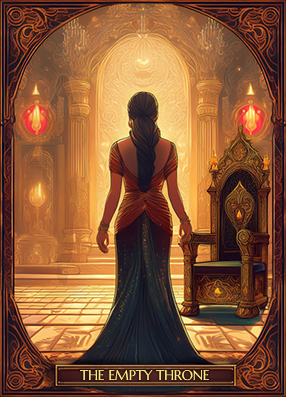
She studied hers. It depicted a richly dressed woman seen from behind, standing at the threshold of a golden throne room. If she looked closely, she could make out a faint, ghostly figure looking back at her.

Something about the woman tugged at her. Her hair, the way she stood—it was too familiar to ignore. Like she was seeing a different version of herself. Maybe someone she might have been, or that she was yet to become.

It was titled: The Empty Throne.

The purse was light, but without it, she had nothing. She’d stretched less before. She could again.

“Breachill, then,” she said, and felt the weight of it settle deep within. Iskaryn landed on her shoulder, sensing the shift in her.

She drew a calming breath, then started walking.

Aemi’s Journal, Arodus 1, 4719

Breachill

Afternoon

I am reasonably certain that my life is cursed. We didn’t make it five minutes into the Call for Heroes before someone literally tried to burn the building down. While I was still inside it.

But I’m getting ahead of myself.

As the norns predicted, I met others carrying Harrow cards, and all six of them seemed just as confused about why they were sent here as I was. Of the seven of us, four received their cards from a fortune teller, one got his from a rat “that was probably sent by a dead goblin”, another one had his literally drop in the lap when he took up the family’s ancestral sword, and, of course, I was visited by towering fey beings of fate.

We are a rather colorful group.

The first person I met was Gath. This actually happened a couple of days ago, and I am pretty sure that Iskaryn set it up, because causing a scene in the middle of the Magdh-damned street in the middle of the Magdh-damned day is exactly the kind of shit she would pull when she thinks I need a nudge. He describes himself as a hunter and tracker of sorts, but the real kicker is that he speaks Sylvan, despite the fact that he’s a human that was raised by goblins. And, no, I am not making that up. He’s the one whose card was given to him by the rat.

Shortly after that, we both met Trip, full name Qantrip, who is a goblin woman and witch that refers to herself in the third person: “A witch is glad to meet you” and “A witch has pickled ears.” And, yes, she was glad to meet us. And yes, she had pickled ears. She offered me some. I politely declined.

This morning, the three of us met the other four.

Tarsius, another human man, is some kind of warrior priest of Nethys, and is “trained in weapon arts”. Which seems a sensible qualification for a warrior priest. He’s the one with the ancestral sword. When it was given to him, he unwrapped the cloths it was kept inside, and the Harrow card fell out.

Liberte is a half-orc gentleman—and yes, that is a deliberate word choice—and scholar—again, I swear, I am not making this up—that is researching Hellknights. There’s an abandoned Hellknight fortress, Citadel Altaerein, about a mile from town, hence why he’s here. His standout line was, “I do this and that. I can usually find a solution other than hitting someone with a morningstar, but there are times when that’s what works best.” Which was kind of an odd way to answer the question, “What do you do?”, but it got the message across.

Marcus, our third human man, is what you might call a mystic or miracle worker. A person marked by the gods, both blessed and cursed. He says he speaks a strange tongue when his blood heats up, whether that be a fight or just a great deal of stress. He’s been living here a while, working as a lumberjack. Because I guess there’s a call for mystic lumberjacks in a town founded by amnesiacs.

Last was Kyira, a half-elven woman from Kyonin, who somehow ended up smuggling refugees out of Galt, a country that seems to be in a state of perpetual revolution. She’s a second mark Firebrand and champion of Milani, which is even more extraordinary for someone who grew up where she did. I imagine her life choices are not especially popular with her elven ancestors.

And then there was me: “I sing and play music.” I have never felt so fucking out of place.

The day started in the Wizard’s Grace, because of course the tradition is for the “heroes” to gather there ahead of the call so they can all eat a hearty bowl of boar stew and lentils, which I could not really afford. There’s something about a tradition where you are expected to pay before you have earned anything that really rubs me the wrong way. (The server actually said to me, “And perhaps afterwards, you can come here and buy a grand meal, when fame and fortune are yours.” Nine Hells. I feel like I’m back in Druma.)

While we’re sitting at this table, looking at each other’s cards, I saw a flash of blue and looked up just in time to see Iskaryn land in the middle of everything. How did she get inside? I have no idea. But she’s never cared about rules before, and there’s no reason for her to start now.

She was studying the cards, so I asked, “What do you see?”

“It’s hardly a coincidence,” she said.

“I didn’t think it would be. We knew to expect this.”

She looked like she was going to say something, but then she saw the server heading over with a broom, clearly intent on chasing her off, and she took the hint.

The others found this curious, and it’s not like it wasn’t going to come out later, anyway, so I hastily explained that she was my familiar. Then the obvious question came.

Tarsius, the warrior priest, asked me, “So you’re a wizard then, too?”

“No.” He didn’t look convinced. “I don’t really understand it, either.”

“The bird seems tame.”

If only. “You keep thinking that. Go ahead and tell her that and see how it goes.”

We continued talking, trying to get to know one another, and it was going as well as you’d expect, which is to say, awkwardly, when Marcus tosses out this gem:

“So, did any of the rest of you have visions of this town burning?”

Um, no? But he’s a mystic, and well, maybe that’s the sort of thing we should pay attention to. Especially when he added “At the hands of Dahak.” The god of all the vile, ill-tempered dragons of the world.

So definitely not an agriculture problem, then.

When the Call time arrived, we headed to the town hall where there was a crowd of townsfolk waiting outside for the doors to open, because people actually attend town hall meetings here. And that’s where we met Warbal, a goblin woman wearing a white dress and what I swear was a mortarboard—by Magdh this town is weird—with silver jewelry, including a butterfly necklace very much in the style of Desna. She was pacing back and forth in fits of worry, almost to the point of outright panic.

We talked to her, and learned she’s the ambassador to a local goblin tribe named the Bumblebrashers (all goblin tribes have names like that), who get along pretty well with the town. They live in the old citadel on Hellknight Hill, because no one else does. The last time Warbal went to meet with them, they didn’t show. So she went all the way out to the citadel herself, and saw red smoke rising from the battlements and interpreted it as a distress signal.

It didn’t take long to figure out that Warbal was at the Call to ask for someone to check on the Bumblebrashers. Especially after she told us as much.

The doors to the town hall opened, and everyone filed in, including Iskaryn because rules don’t apply to her, and when the meeting started, that is exactly what Warbal did. Except she didn’t get a chance to finish, or hardly even get started, because a guard burst into the hall from a side door and yelled, “Fire!”, and flames erupted into the room from behind him. Then panic set in.

Lots of people froze. And I understand that. I’ve been in a situation I’d rather not remember, and I froze, too. The best thing you can do for people who freeze up like that is what was done for me, then: tell them what to do.

So I stood and yelled, “Everybody out the main hall door!” And I even cast a spell to light up the exit, because it solves the problem of people looking around in a panic, and because panic makes even obvious exits hard to see, especially once the smoke sets in.

Then a fiery elemental creature came in through the open doorway, and then a door from the back of the hall opened up and a second one came in, and they were spreading flames everywhere they moved. And then the real panic set in.

Our newly formed group of fated heroes, or whatever you want to call us, split into two. Half of us helped get people out of the building before they died from smoke inhalation (and directed them to form a bucket brigade), and the other half went to confront both the fire and the elementals that were spreading it. The first went well. The second? Did not. 

Fortunately, the fire creatures were the result of a summoning, because weapons and spells weren’t really accomplishing much. They disappeared, and the water buckets were able to extinguish the fires before the whole building went up.

Outside the hall, in the aftermath of all this chaos, someone—I think it was a town guard—identified a halfling named Calmont as the arsonist, and said he ran off towards the citadel. Which is enough of a coincidence to raise questions. We were deputized on the spot, given a paltry sum of money that might last me another week if I forwent luxuries like food, and tasked with bringing Calmont back alive for questioning and, I assume, a trial.

Who is Calmont? An excellent question, since we didn’t really know many people in town. Prior to his career in arson, he was an assistant to the local book seller, Voz Lirayne. We all agreed we should pay her a visit before heading out to Hellknight Hill.

I like to multitask, by which I mean, I like to use Iskaryn for something other than giving me a hard time. So I asked her if she would be willing to scout the citadel for us. And, naturally, because there was an audience, she gave me a hard time.

“Do you think these are things that are going to shoot at me?” she asked.

“You look like every other bird, right?”

“I might look like dinner.”

I decided to call her bluff and said, “Yeah.”

“So that’s what you’re saying, then?”

“Yeah.”

“You take a lot of risks with me,” she said in her best, disapproving tone. “Sure. I’ll go scout the dangerous castle for you.”

When she gets like this, it’s best to just be polite. “I appreciate it.”

“You don’t pay me enough for this.”

And then I lost my temper. “I don’t pay you at all.”

“That’s my point!”

You cost me more—”, I started, then cut myself off as I realized we were getting into an argument in the middle of the Magdh-be-damned street. Again. “Never mind.”

“You know,” she said, “I don’t want to hear about it.”

Fine. Whatever. Just go.

I turned to the others and said, “Iskaryn has agreed to scout out the citadel for us.”

Gath said to me, “You know you two do sound like a married couple, right?”

“Let’s go visit the bookseller.”

The Reliant Book Company turned out to be a seller of rare and magical books, and Voz was exactly the sort of pretentious proprietor one expects to find running such a place. Back in Druma, this sort of thing is a familiar sight. I used to think that was the mark of a good merchant. A lot has happened since I left that life behind, though, and now I mostly find it insulting.

Still, we were here to get information, not adjust her attitude.

“Can I help you?” she asked as we filed in.

“Hello! My name is Aemi. We were just at the town hall, and a gentleman by the name of Calmont was directly implicated in trying to burn it down. While people were still inside.”

She took this news about as well as you would expect.

What?!

“Yeah. Including us, by the way. We were inside, too. We’re just hoping to learn a little bit more about Calmont. The city has tasked us with the investigation.”

“Maybe that’s why that little fool didn’t come to work today.”

Uh-huh, maybe.

Calmont worked for her doing, as she put it, “menial tasks”, which included cleaning, rearranging books, and even some simple book repair. He was a relatively new hire. Lately he’d become unreliable, though we never got a good explanation for what that meant. With a little more questioning, and a bit of “encouragement” from Liberte—who implied that he might actually solve this problem with the application of a morningstar, just in not so many words—Voz agreed to let us search the room he was renting from her.

We didn’t find anything particularly damning, just some scribbles that suggested he was under a great deal of stress, and that his only way out was to “find the ring”. That sounded like desperation more than a plan.

And what ring would that be?

No idea.

Iskaryn returned not long after with her report on the citadel. There were goblins up on the battlements, cowering in fear of something, but she couldn’t see who or what. There were no obvious watchers or guards.

And I could tell right away that she was still in a mood. We were discussing some logistics, including what we’d want to take with us and who would carry what, when she said, “I’m not carrying anything.”

“I don’t expect you to. I don’t even want you in there,” I said.

“Suits me just fine. I’m just glad I didn’t get shot at.” 

This again. I rolled my eyes. “You know, you were a scout for a couple of weeks.”

“I’m not forgetting that either.”

We agreed to meet up in half an hour, which would give us time to gather what we needed for the trek up the hill. I went back to my space at The Dreamhouse and grabbed my armor, being sure to give Iskaryn the stink eye on the way out because she deserved it.

Petty of me? Yes. Satisfying?

Also yes.