Rova 17, 4719
Some River, Mwangi
Noon
Today took a bit of a turn.
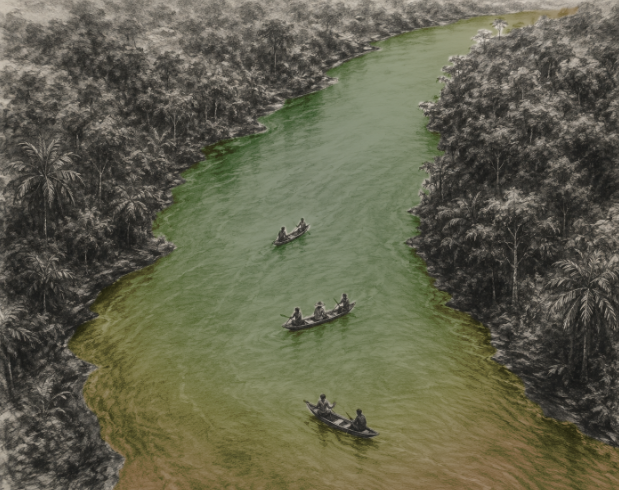
We took the canoes downriver, intending to reach the elephant people’s village, but after just a few miles we spotted a large boat moored to a tree, and I guess curiosity won out.
We pulled ashore to have a look. Whoever had been there had stomped off to the north, leaving a trail that even I could follow. Iskaryn went ahead to scout it out, and while we waited for her to return, Gath poked around the boat and found a small bundle wrapped in oiled canvas.
Inside were a handful of journals from some self-aggrandizing explorer, a number of gold idols, and various small treasures. We were actually surprised to see gold, but Renali pointed out that it’s just the Ekujae elves that consider it taboo. Then she said something else interesting.
“There are old ruins everywhere. You can find things like these if you’re willing to go digging through someone else’s shrine for them.”
I didn’t think much of this at the time.
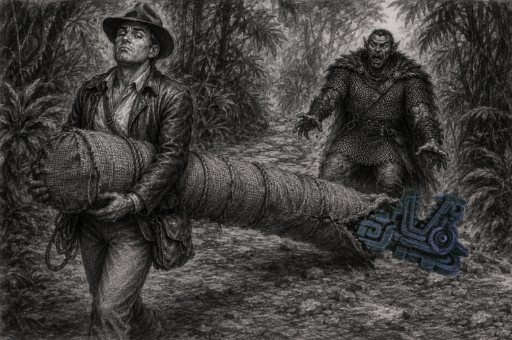
When Iskaryn returned, she said the trail led to a clearing with a number of bodies in it. The only one still moving was a human man trying, and failing, to transport a large object also wrapped in oiled canvas. An object about the right shape and size to be a dragon pillar.
We waited for a bit, and when he didn’t turn up, we figured he wasn’t making much progress. We didn’t want to sit out here all day, so we went to meet him.
And it was a lot worse than “not much progress”: it was essentially “no progress”, and he beamed at us when we appeared, introducing himself as Gerhard Pendergast in a tone that suggested we were lucky to come along just in time to help.
Or, almost in time. Iskaryn hadn’t really been specific about what she’d seen. There were dead Cinderclaws behind him, yes, but also several stone statues that looked eerily lifelike.
This pillar was quite a bit nastier than the one we had dealt with a couple of days ago.
I guess we were supposed to recognize Gerhard, because he looked disappointed when we didn’t. So he started telling us, in case it jogged our memories or something, and finally Liberte interrupted him and said, “Do you know how dangerous that thing is you’re carrying?”
And, I mean, he obviously did, since the statuary behind him was made from his porters and assistants. He just didn’t know the whole of it.
“Well, not anymore. My lads disabled it, you see.” And I think I can just leave that there.
Liberte pressed him on the pillar itself. “Do you know what it is?”
“Why it’s…it’s a rare jungle totem…that I have taken from this…er…site—”
I cut him off. “In other words, ‘No.’”
We pointed out that this was the third one of these we’d come across, and they did a bit more than just defend themselves. Which set him off again like we were competing with him for some museum exhibit or something, and trying to cut into the fortune he planned to make from it. And, obviously, that was the last thing on our minds: we just wanted to disable the damned thing without coming to blows over it.
Then someone has the brilliant idea of agreeing to help him carry it, and a few of us step up to do that. And just as they get some momentum, Liberte lets his end slip from his grasp at just the right time, and the pillar falls to the ground just so, and then splits down the center.
Problem solved.
He was obviously upset over this, but there are spells for that, and museums do this sort of thing all the time (how they decide between restoring something with labor, restoring with magic, or not restoring at all is a mystery to me, but I assume they know their business). Fix it, not fix it, we just didn’t care.
And I didn’t think much of that at the time, either.
But now something is nagging at me. The whole time we were talking, or perhaps arguing, with the man, he kept referring to his “discovery”. And then there were his journals, which Gath had read excerpts from aloud, and they were full of words like “discovered” and “rescued” and “recovered”. And so on.
I’ve been to museums. When I was sixteen, my parents took me to an exhibit called Music Before Earthfall, which had a collection of ancient Azlanti instruments. I still remember the wave harp. It was this strange thing with three vertical rods made of mithral, and you didn’t even touch them to play it. You plucked at the air between them, and somehow it produced musical notes. And next to it was this little placard that said something like “Wave Harp, Late Azlanti period. Recovered from the submerged remains of…” someplace. I don’t remember where.
But there was that word “recovered”.
A couple of years later, I was at another exhibition, Songs of the Pharaohs, about the music of ancient Osirion, and I remember seeing a ceremonial harp. And it, too, had this placard that read, “Recovered from a tomb outside Sothis…”, and it was on loan from some private collection in Oppara, which is in Taldor.
And again, there was that word, “recovered”.
And I didn’t think much of those at the time, either. But now I think back to what Renali said earlier, about digging through others’ shrines to find these little golden idols. And then there’s Pendergast “discovering” this dragon totem.
He’s writing those little placards in real time.
And worse, he doesn’t even know what they are.
And now I’m looking at those placards in my head, and well, they can really just say anything, can’t they? And what does “recovered” really mean?
Night
Late in the day, we caught glimpses of a small group in the distance that appeared to be tracking us. Which was probably not difficult to do, because we weren’t going out of our way to hide our passage. Kind of the opposite, really: we were dragging the canoes behind us as portage. You couldn’t not track us.
Our trail was so clumsy that we figured an ambush had good odds of working. And, as hard as this is to believe, I played a significant part in our audacious plan.
I knew I could weave magic into my music and captivate an audience—the weaker the will, the easier it was—and even influence their actions. It’s the sort of thing you just don’t do in polite company, but this little meeting would be miles from polite. We found a suitable clearing in a copse of trees to make camp, and Tarsius and I sat together in the open while the others disappeared into the woods along the approach.
We were the bait.
I played something soft and airy while we waited. When four boggards and one charau-ka came into view, I wove the magic into it, and ensnared every one of them.
It wasn’t perfect. There were more boggards that I couldn’t see, and two of the five broke free when my friends started picking them off, but I held the rest.
And then it occurred to me that we had more options than fighting them.
I turned to the first in line, pushed more magic into the music, and said, “Run home.” They resisted, but the next two didn’t. One at a time, they took off into the jungle as fast as their legs would carry them.
It seemed pretty clever at the time, but in retrospect, maybe it wasn’t the best idea. We’re not here to merely inconvenience the Cinderclaws: we’re here to eliminate them. Which sounds horrible, sure, but it’s also true that they are horrible people who worship a horrible god, with horrible plans for the rest of us. So there’s not a lot to love there. But sending them on an hours-long journey made things easier on us, and there’s still this part of me that would rather avoid this sort of violence when we can. Two boggards likely won’t make a difference in the end. And no one is upset with me. More the opposite, really. So I don’t know what the right thing was. Maybe there isn’t one.
We kept one of the boggards for questioning. From him (I think he was a him; I don’t know, and I didn’t ask), we learned a few things we had suspected—they knew we had disabled the green pillar and came looking for us—and quite a bit we didn’t know at all.
There are still a red, orange, yellow, and indigo pillar out there, somewhere. That indigo one is a bit speculative, since he wasn’t too good with colors, but we’re just going to run with “indigo” for simplicity’s sake. There was also a strange comment that suggested “colored walls” of some sort, though he wasn’t clear on that either.
Both the gold mine and their fortress are upriver. While that doesn’t exactly narrow things down, this lot was dispatched from the fortress, so the fortress can’t be more than a couple of days away at boggards-traveling-with-charau-ka speeds.
Their high priestess is named Belmazog, but we got little else about her. The boggards seem to be nothing more than muscle, and all he could tell us was that she was the smartest of all of them. Though that doesn’t tell us much, either, since it seems like that’s a low bar to clear.
When we were done, we let him go.
And I don’t know if that was the right thing, either.
Rova 19, 4719
Some Village, Some River, Mwangi
Late Morning
Iskaryn is feeling very proud of herself. Normally, that kind of comment from me would be followed by several lines of exasperated snark, but this time? She earned it.
We were seeking out the elephant people. That name is not as exciting as it sounds. My understanding is that this isn’t even what they call themselves, and it’s just a term the Ekujae use for them because they live near a herd of elephants. Apparently, neither the elephants nor the people are particularly friendly, but the two seem to get along with each other—however that works when you live next to wild animals, especially ones that are both aggressive and capable of knocking over mature trees, without them killing you—so the Ekujae just put the two names together. Hence, elephant people.
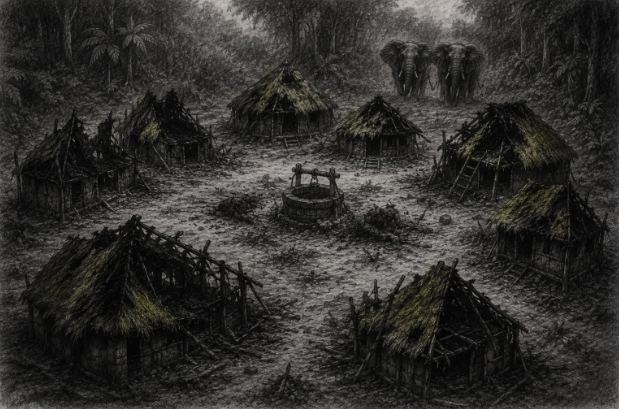
We found their village. Or rather, what was left of it: the entire place had been burned to the ground. The only structure left standing was a small stone well. Everything else was just charred timber collapsed into heaps on scorched earth.
We immediately suspected Cinderclaws, because who else would do this? That was confirmed when we saw the crushed remains of two charau-ka.
See above about unfriendly elephants.
Unfortunately, two of said elephants were still here, and they were not thrilled to have visitors. We would have just turned around and left—the whole point of coming here was to talk to these people; no people, no talk—but then we heard someone crying for help underneath one of the piles of rubble.
It’s difficult to rescue someone when you’re being charged by elephants, or so I imagine. Qantrip stepped forward to try to calm them, and I wove a bit of magic into my music to help, but it only seemed to make them angrier. Everyone’s a critic.
That’s when Iskaryn darted forward. I both heard and felt it when her birdsong started because she pulled on my magic.
And the elephants just stopped.
It’s what I’d done a couple of days ago with the boggards. But this was Iskaryn doing it. Iskaryn. We’d passed a song back and forth to strengthen my friends before, but this was different. She just…took over, and changed it. Used it the way I had.
My lasting image of this is a small, indigo bird staring down two elephants a hundred times her size.
I couldn’t believe it. I kind of still don’t.
Later, I asked her, “How did you know you could do that?”
“I didn’t,” she said. “But it seemed like a good time to try.”
My friends managed to free the trapped villager, and he was able to calm the elephants once Iskaryn dropped her song.
Unfortunately, he didn’t have anything to tell us that we didn’t already know. But I’ll accept “probably saved his life” as a good reason for coming here.